Friday, March 09, 2007

Technology makes people stupid.


That’s my theory. I have no proof to back this up. I claim no special insights, other than direct observations about my fellow humans. And it may not be “stupid” as much as it might be things like “easily distracted”, “self-centered”, “lazy” and “impatient”. “Stupid”, although grammatically not correct for the concept I am trying to get across, is my way of lumping all those other terms, and more, into a single, all-encompassing, easily understood, high impact word. I think “stupid” works.

I am not certain where I think that the current technology overkill originates. Certainly, the constant pressure on industry to come up with yet one more “bright shiny thing” that becomes the next “must have” item on store shelves contributes to this. Corporations are flooding the market with high end, high profit gadgets of all types, marketing them to teenagers, young adults and other with expendable income at the ready. If you keep waving bright, shiny things in front of people long enough, they will eventually decide that they really need to have it. In other words, demand didn’t cause the product. The product came first, then the demand came in a rising storm for things that people didn’t even know existed, but yet had to have once they found out about them.

However, I also think that the consuming masses are just ripe for this type of manipulation of demand. People these days, young and not-so-young alike, desire to be distracted. They don’t want deep thought. They desire something new and different, something to impress friends and build up their own self-esteem by owning something that no one else has. This fits in very nicely with the overall trend of our society toward ever-flashier, ever-faster moving assault on our senses just to get our attention. Even something as simple as a razor (shaver, not the cell phone), with which one accomplishes the menial task of shaving whiskers from one’s face, must have an advertising campaign more worthy of Ferrari racing team than an cheap instrument with sharp edges that you use once a day for three minutes.

In other words, the consuming masses are already primed for the “newest”, “hottest”, “trendiest” (aka, NHT) item by the overall trends in society. It doesn’t take a marketing genius to figure out a way to see these mostly high-end, technologically advanced gee-gaws to the masses. Owning these items, whatever they might be, gives the owner a sense of satisfaction that they own the NHT item. It is an ego-stroking experience. At the same time, it gives the owner something to focus on, rather than the very real, very pressing issues that confront our society. “Don’t have time to worry about global warming! Gotta go home and set up my new flat screen, hi-def TV with Surround Sound ™!”

I think the full-scale explosion that is going on in hand-held, portable devices provides a good illustration. I can accept that a small, totally portable telephone that you can use whenever and wherever you happen to be is a wonderful advance. Great device. People are not always at home to take phone calls, especially not in these hectic days. Being able to take a phone call while waiting in an airport for your plane or while at your son’s Little League game is invaluable. However, just because they could do it, telephones constitute only a portion of what is now available. You can send a text message to someone. You can talk with them via a “walkie-talkie”. You can play video games. You can take and send pictures and short movies. You can download movie trailers from the latest Hollywood offering and view sports clips from yesterday’s big game. You can download your e-mail, send an e-mail, coordinate your schedule, ad infinitum. Phone calls? So 1990’s…..

My question is, do consumers actually NEED all these abilities? Or are they just more bright, shiny, distracting things? I once saw a scene that has stayed with me. It was a normal enough thing; just three young girls walking down the sidewalk after school one day. However, all three of them were yakking away on their cell phones. It just seemed to me that, if they were close enough to hang out with each other, they should maybe just talk among themselves. Perhaps? Or is the method of communication, i.e., the NHT cell phone, more important than what you are communicating and who you are communicating with? I have seem people, usually younger females, talk for long periods of time during a live sporting event. I was thinking, “Just why did you come to this game, since you seem so terribly uninterested in what is going on?”

And this is just the “telephone” part! I cannot, for the life of my, fathom why industry is busy constructing a hugely expensive, highly capable wireless system across the country so that people can download movie clips or sporting highlights. They could watch those at home, or at their nearest movie theater. Sure, I am being unfair, but only to a point. Many businesspersons use wireless connections for their laptops to actually do work while away from a desk-bound workstation. But a large percentage of the country’s very expensive, high-end, technological-dependent infrastructure seems to exist only so that 15 to 28 year olds can amuse themselves with very expensive, high-end, technological-dependent toys.

We’re hooked on technology. We have to have it, and we have to have the NHT, right now! I have heard second and third hand accounts, and read articles, about people who actually start suffering physical withdrawal symptoms and emotional anguish is they are not able to use their latest NHT device. Network down? Can’t check your e-mail? Full-blown crisis mode! It doesn’t seem to occur to people that they can wait until they are back at the office. The world is not going to come to an end if you can’t check your e-mail RIGHT NOW. Working people back in the 1980’s actually made do with typewriters and a hand held telephone that could crack a skull if you hit someone in the head hard enough with it, and we seemed to make it out of that decade O.K.

If religion is the opiate of the masses, as Karl Marx once pronounced, then technology seems to be a close second. Or, another way of looking at it might be more of Caesar’s “bread and circuses”. Lots and lots of nice, shiny, distracting things, so the population won’t see what is going on in plain sight if they would just pay attention to the magician’s other hand for a while.

Tuesday, March 06, 2007

Thoughts on how the Earth came to be capable of sustaining life.


This is about a bit of a theory that I have had for some time that puts together a lot of info from a lot of different topics that could explain the “Big Picture”. Why do we have a habitable planet when it appears that the odds, cosmologically speaking, are very long against it? When you step back and look at it in a dispassionate and objective way, it does appear that the Earth’s existence, in its present form, may represent a very unlikely occurrence.

I keep thinking that someone out there must have done this before. However, I have not quite seen it all assembled in this manner before.

Contrary to the process of normal scientific inquiry, I’ll start with my conclusion first. I’ll then explain how I got there.

Conclusion as Prologue

I don’t think that intelligent life is as prevalent out there in the universe that we might think it is. Certainly, given the immense size of the universe and the number of planets out there, something MUST have happened out there that resulted in a planet that resembles the Earth. But, I am thinking that the possibilities aren’t as high as some out there have proposed. Here is my reasoning.

A stable provider of light and energy

The first thing that we obviously need in order to concoct an environment friendly to life is a stable energy source. That is, of course, our Sun. Stars like ours are very common in the universe. However, so are many other kinds of stars. There are huge stars, such as Betelguese, which will live for many times the life of our Sun but whose surface temperature is little more than burning charcoal. There are tiny white dwarf stars which burn hot but have a relatively short lifetime. There are huge white hot stars, such as Rigel. There are all sorts of binary stars, which would make life difficult for planets to even exist, much less orbit the star in a stable orbit. There are variable stars, some of which oscillate in energy output by several orders of magnitude.

We must also have a stable local (galactically speaking) environment, free from harmful effects of such nasty, esoteric denizens of the universe, such as pulsars, quasars, x-ray bursters, etc.

To whit, the Earth does not exist by itself. The Earth exists within its own environment. In order for life to exist on this planet, we need a stable source of energy without any harmful interference from outside sources. With that accomplished, we can move on.

The habitable zone surrounding the Sun

The Earth is situated in an orbit around the Sun that lies within a relatively small window that would sustain life as we know it. Water is the key, of course. Without water, there would be no life as we know it. In our particular orbit, water is warm enough to remain liquid but yet, not hot enough to evaporate. Therefore, our Earth had to have formed within this small orbital window for to even allow a chance of life beginning. Also, the Earth had to be the right size and right density in order to maintain an thick (but not too think) atmosphere, once it had established one.

This habitable zone looks to extend somewhere between the orbit of Venus and the orbit of Mars. Any further closer to the Sun, and you have a baked ember of a planet like Mercury. Any further from the Sun, and you would have an iceball whose oceans are ice and whose atmosphere lies frozen on the ground. Fortunately, the Earth seems to reside in just the right place. We experience water in all three states (i.e., solid, liquid and gas). Life has been shown to be very resilient, as underwater hydrothermal vents teem with life and can withstand being frozen in the artic winters, only to be reborn during the spring and summer months. However, too much of either heat or cold would have doomed any aspiring life form on primordial Earth.

Where did the moon come from, and why is it important?

Why is the planet Earth the only one in the inner solar system that has a very large moon? Both Venus and Mars resemble the Earth, in a way. The size and distance from the Sun are all within some comparable parameters. Venus has no moon, and Mars has two small moons that probably don’t even deserve the really intriguing names with which they are endowed. Given those observations, one could conclude that something very unusual must have happened to the Earth back when the solar system was still a pretty dynamic place.

Most current theories regarding the formation of the Moon involve a collision between a proto-Earth and another Mars-sized planet or planetesimal. Computer simulations show that the only type of impact that would have resulted in enough material in an orbit that won’t fall back onto the Earth is a side-glancing blow. A direct hit would not have produced the “planetary pair” that we see today. The other theories, such as a planetary capture and both the Earth and Moon coalescing out of the same disk of material, don’t really stand up to computer simulations.

For more information on this theory, check out this link, and this one, and then this one.

It appears to me that, although nothing is certain in the areas of scientific theory, that the collision theory is the one that stands up best when trying to explain the system that we have right now. And if the state of Uranus is any indication, collisions of major sized bodies early in the formation of the solar system was not an unlikely thing to occur. How else does one go about explaining that Uranus is tipped on its’ side, with it’s axis of rotation pointing in the plane of the solar system disk? Something pretty darn big must have hit that planet to make that happen.

The role that the Moon played, and continues to play, in creating an environment that can sustain life is discussed below.

Plate tectonics, volcanism and the atmosphere

What is another feature that the Earth has that neither Venus nor Mars has? The answer is tectonic plates. Unlike the Earth, neither of those two planets seem to have a crust made up of large pieces. This points to something unusual in the Earth’s past that did not occur with the other two. This is one connection that I have not seen anyone else make before. I believe that it is not a giant leap of deductive reasoning to think that the same planetary impact that ultimately resulted in the Moon also shattered the Earth to the point that the crust broke into continent-sized chunks that are still with us today.

A direct outcome of the fact that the Earth has huge plates that float upon the Earth’s mantel and grind into each other is earthquakes and volcanoes. Yes, Mars has evidence of volcanoes; really big ones, in fact. But there is no evidence that any of Mars’ volcanoes are still active, and it certainly doesn’t have anything resembling the Earth’s “Pacific Rim Ring of Fire”, which contains a vast number of volcanoes, both active and dormant.

Volcanoes provide an excellent method of establishing a planetary atmosphere. Certainly, it’s very toxic at first. But even a toxic atmosphere establishes several things. One, it provides a basis for a constant energy exchange between the oceans and the atmosphere. It evens out the temperature around the globe, such that if one portion of the atmosphere becomes very hot or very cold, the law of thermodynamics rather insists huge extremes do not exist. Water is transported around the globe to places that normally wouldn’t see any water. It’s acts as a protective covering for the water that does occupies a large portion of the surface of the globe, such that it doesn’t all just evaporate into space and lost forever.

Of course, one form of life’s toxicity may be a fundamental requirement to another. High amounts of hydrogen in the atmosphere released by the volcanic activity enabled microbes to develop that consumed hydrogen and produced, as its waste product, free oxygen, which is one of the basic needs of our current form of life

Earth’s stable rotation

Another thing that the moon provides the Earth is a stabilizing force that helps keep the Earth in very stable rotation around its’ axis. The Earth rotates about its axis like a huge gyroscope. A gyroscope exhibits a number of behaviors including precession and nutation. If the Earth exhibited such behavior, the global climate would experience wild fluctuations, so much so that life would have had a difficult time to establish a toe-hold. I doubt life, during its very tenuous beginnings, would have fared well if its local climate were sub-tropical one year and arctic-like the next. Oh, it certainly may have, but I would imagine life would have had a much harder time of it without a stable local environment.

However, the Moon provides a giant “stabilizing force”, which forces the Earth’s to have a very stable rotation. This allows a very predictable, long-term environment to develop which would be infinitely more conducive to allowing life to develop than the one described above.

Tides and tide pools

There are still varying theories about how life actually came be on planet Earth. Did a soupy combination of organic materials spring to life on this planet? Were, somehow, life containing molecules deposited on the Earth from cosmic bombardments? However it happened, it is likely that life really was able to itself the interface between water and land. Tide pools provide a shelter from the direct effects of the ocean’s waves, while allowing in replenished water and nutrients on a regular basis.

From solstation.com: Bacteria formed microbial mats on land as early as three billion years ago. Fossilized remnants and other biochemical evidence from South Africa suggest that photosynthetic bacteria (primarily blue-green cyanobacteria, that may have included the ancestors of Chroococcidiopsis) may have colonized the wet surface of clay-rich soil during rainy seasons, but were blanketed by aerosol deposits laid down during subsequent dry seasons. Such mats may have formed in surface pools, water edges, and other wet spots on land (Press briefs from the NASA Astrobiology Institute of 2/5/01 and 11/29/00, and from the University of Pennsylvania).
The Moon is responsible for the regular tides in the ocean, which enables the life enabling tide pools to exist.

The magnetosphere

Another thing that the Earth has that Mars doesn’t, besides oceans, a thick atmosphere, plate tectonics, active volcanoes and a very large moon is a very large magnetic field surrounding the planet. In fact, of all the four inner, rocky planets in our solar system, the Earth is the only one with a large magnetic field. Given this rather statistically limited number of examples, it still must be assumed a magnetosphere is not a given for planets otherwise capable of harboring life (caveat: life “as we know it”).

Why is this important? Well, because our planet needs to be in rather close proximity to the Sun in order to receive the amount of energy necessary for life, we are then exposed to different type of hazard; the solar wind. The solar wind, which sounds harmless enough, is the violent stream of highly energized particles coming off of the sun’s corona. The radiation alone, if allowed to pass directly onto the Earth’s surface, would be enough to disrupt and even damage fragile organisms. As an illustration, all astronauts in the International Space Station are ordered into a very protected room where they cannot be harmed by the gamma rays that result whenever very large sunspot activity occurs.

However, with the Earth’s substantial magnetosphere as protection, we have an “umbrella” in place that protects the entire planet from these harmful rays. One need look no further than the Aurora Borealis (that is, the “Northern Lights”) to see this protective umbrella in place. All the highly charged particles are funneled north or south into the Earth’s magnetic poles. The interaction of these particles with themselves and with the Earth’s atmosphere can be seen as a brilliant curtain of light. While beautiful and awe-inspiring, the Aurora is rather a sideshow compared to the most beneficial aspect of the Earth’s magnetosphere. Without such a protective umbrella, the Earth may have lost all of its atmosphere, as well as all free water vapor (including the oceans) to the unrelenting blast from the solar wind over the course of millions of years. The Earth would look like a bigger version of Mars; lifeless (as far as we know) and water only exists in protected locations such as the poles, in the perpetual shadows of crater walls, and underground.

If the Earth had no magnetic field, it is doubtful Earth would have been able to harbor such abundant life.

The giant gas planets as protectors

One other destabilizing force in the rise of life on Earth is having your global climate very suddenly changed due to impacts of huge meteors and comets. As most laypeople know, one of the leading theories about why dinosaurs are extinct is that the Earth was struck by a large comet, meteor, or asteroid, and this caused both short and long term effects that altered the dinosaur’s habitat so significantly that they were not able to continue as a species. This theory is still under debate, and I won’t go into that here. But I think it is safe to say that life would have had a very difficult time of it if faced with disruptions of this magnitude occurred with any sort of regularity. The amount of energy released during one of these collisions is enormous, as we witnessed in 1994 when multiple fragments of Comet Shumaker-Levy 9 slammed into the planet Jupiter. If the Earth were to sustain one of these types of impacts, as an wild guess, every 10,000 years, Earth’s entire ecosystem would essentially be “starting over” each time.

Therefore, it is very indeed fortunate that our solar system is equipped with a giant vacuum cleaner, in the form of four gas giants (Jupiter, Saturn, Uranus and Neptune) that operate in the outer portion of our system to sweep the solar area clear of most (but not all) dangerous rogue floating space bodies. Without these impassive hulking planets to act as our protector, Earth might still be experiencing a pounding that all planets and moons experienced during the formation of the solar system. One need look no further than the surface of the Moon or the moons of Jupiter and Saturn to see the violent history of planetary formation recorded in their scarred and broken surfaces.

Jupiter’s stable orbit.

It is also a very fortunate thing that these same gas giants are in a stable orbit around our Sun. This does not appear to be a given. There are something in the excess of one hundred extra-solar planets that have been discovered orbiting around other stars. Given the limitations of our detection capabilities, scientists and astronomers, so far, have been limited to detecting very large planets, on the order of Jupiter. However, what has startled astronomers has been the fact that many of these planets appear to be orbiting their parent star in a very close orbit. That is a mystery that has yet to be explained. No theory of planetary formation has yet come up with a explanation of how a large gas giant could have evolved in that close proximity to a star. The material which makes up the planet should have been subsumed by the star’s accretion disk during the star’s formation. So, how did those huge gas-giant planets find themselves in such a close orbit to their suns?

One theory that seems to explain this seeming mystery is as follows. If the planet could not have formed that close to its sun, then it didn’t. So, how did it get there, there? Applying either Occam’s Razor or Sherlock Holmes (whichever suits), the planet therefore must have moved there. Where did it come from? From a decaying orbit much further from the star, where it could have formed in the same way that Jupiter and Saturn formed in our solar system. However, for whatever reason (but that reason seems to be somewhat prevalent in the universe, based on the number of examples astronomers have discovered) the planet, over the eons, had a decaying orbit, which caused the planet to slowly spiral inward to where it is now in close proximity to its sun.

This goes without saying that it would be catastrophic to the rest of the planets in our solar system, if Jupiter or Saturn decided on following the same course. Any one of the four gas giants would gobble up any other planet, large or small, that lies between it and the sun. Therefore, it is indeed fortunate for us that all four outer gas giants stayed put in their own stable orbits after they formed. Otherwise, they would have been vacuuming up Earth, Mars and Venus instead of just cleaning up stray comets and asteroids.

Conclusions revisited

Given all these rather amazing circumstances surrounding the Earth and its neighborhood, I can only conclude that we are very fortunate to have such a pleasant and nurturing environment in which we live out our collective mortal existence. If you remove any single one of the circumstances described above from the history of our solar system, the Earth today would be a drastically different place than it is and may not have been capable of sustaining life. The Earth might resemble the hellish planet of Venus, or the dry, cold and airless planet Mars, instead of the relative Garden of Eden it does now, or may not even exist at all.

Of course, “scratching the surface” doesn’t even come close to describing our limited observations about the universe. There are millions of galaxies out there, each containing billions of stars. That’s a lot of opportunities to roll the equivalent of two thousand “snakes eyes” in a row while playing dice, which it looks comparable to what occurred in the history of our solar system. All the necessary and sometimes downright unusual events necessary to provide us with this environment conducive to life and protecting us from all the harsh conditions that exist in the universe occurred. How likely is that? Not very likely, in my mind. That is why I said, at the beginning, that intelligent life in the universe may not be as high as some have supposed.

Now, as to how these developments all lined up in just the right way, some people would use this as evidence of a Devine Influence. Nothing this complicated or unlikely could have ever come about on its own. That is a very similar argument many people make when discussing evolution vs. creationism. The odds look impossibly long for it to have happened (i.e, 2000 snake eyes in a row), so therefore, “someone” must have been behind it. “In the Beginning, God created the Heaven and the Earth.”

A competing concept is sometimes referred to as “the Theory of Serendipity”. In short, it goes something like this. “Because we are here, it must have happened that way.” To me, that sounds more plausible than hypothesizing a “Creator” who concocted the entire universe but yet, somehow, exists outside of this observable universe. Someone has to win the lottery eventually. Why couldn’t it have been us?

Either way it ultimately came down, what we have right now is a planet that is warm, friendly, protective and nurturing which provides us our many needs, both real and imagined. We should treat it much better than we are currently doing. It may not be very long before it comes back to haunt us in a very big and unpleasant way.

Friday, March 02, 2007

The population bottleneck and confidence in the scientific method.


I have been reading some material and watching several shows on the Discovery Channel (I think) about the human population bottleneck. Here is what Wiki says about it first:

A population bottleneck (or genetic bottleneck) is an evolutionary event in which a significant percentage of a population or species is killed or otherwise prevented from reproducing, and the population is reduced by 50% or more, often by several orders of magnitude. Population bottlenecks increase genetic drift, as the rate of drift is inversely proportional to the population size. They also increase inbreeding due to the reduced pool of possible mates (see small population size).

A slightly different sort of genetic bottleneck can occur if a small group becomes reproductively separated from the main population. This is called a founder event.

Human mitochondrial DNA (inherited only from one's mother) and Y chromosome DNA (from one's father) show coalescence at around 70,000 years ago. In other words, all living humans' female line ancestry and male line ancestry trace back to a small number of people alive at that time. However, such coalescence is genetically expected and does not indicate a population bottleneck, because most human ancestors are neither female line nor male line ancestors (for example, one's mother's father's ... mother's father). A population bottleneck would only be indicated if DNA coalesced more recently than genetically expected.

The Toba catastrophe theory suggests that a bottleneck of the human population occurred ca. 70,000 years ago, positing that the human population was reduced to a few thousand individuals (and possibly as few as 1,000 individuals) when the Toba supervolcano in Indonesia erupted and triggered a major environmental change.

In 2000, a Molecular Biology and Evolution paper suggested a transplanting model or a 'long bottleneck' to account for the limited genetic variation, rather than a catastrophic environmental change.


The upshot is this. By examining human DNA taken from numerous examples from around the globe, scientists have concluded that the human population, about 70,000 years ago, almost went extinct. The reasons for this are speculative. However, the dates line up very well with the eruption of the Toba super volcano in Indonesia. Eruptions of that type are suspected of having long term, disastrous effects on climate at the global level.

As interesting as that is to me, that isn’t what I want to talk about here. I would like to address this concept of the population bottleneck. I am astounded that, by examining human DNA, researchers can come to the conclusion that the human population dwindled down to perhaps as few as several thousand people.

First of all, I do not understand what the researchers are actually looking at to make that conclusion. Further, from my understanding, these same researchers have concluded that this small population lived somewhere in the vicinity of eastern Africa, such as modern-day Kenya.

The second point that I do not understand (given that their hypothesis is correct), is how anyone would know what the world’s population of human breeding stock (let’s be honest, that’s what we are talking about) looked like on the OTHER side of the bottleneck. Given that the breeding population, at some point, reached that very low number, how do researchers know that there was ever any significantly greater numbers than that? The concept seems, to me, to be similar to the cosmological Big Bang. By the very nature of the event, all evidence of what the universe was like before the Big Bang has been destroyed. No conclusions about what existed prior to the event can be reached by using the scientific method.

However, this is where my belief in the scientific method comes in. I know, for a fact, that what these scientists and researchers are doing isn’t just a bunch of strung together, unsupported opinions and conjecture. The papers that have been published on this subject have been subjected to rigorous peer review. I know next to nothing about human genetics. However, I am confident that the people doing the research are following the procedures and that their conclusions that they have reached are valid. They are not necessarily “true”, but they have been subjected to rigorous scrutiny and competing theories that would explain the observed results have been evaluated. Therefore, I have no problem in accepting this hypothesis, even though this is nowhere near my area of expertise. I think this is a fascinating area of inquiry. It says that the human race may be very, very fortunate to be here at the present time.

This is why I think what the Fundamentalist Christians are doing with regard to raising suspicions about any scientific conclusion they don’t like is so damaging. When flagrantly dismissing very well founded scientific theories such as evolution, the age of the earth, the age of dinosaurs, and global warming, they are stating that opinion is more important than conclusions reached by the scientific method. If someone comes up with theory that has been arrived at with meticulous methods by trained scientists specializing in that field, you are free to discount it if that theory conflicts with your own prejudices and pre-formed opinion. We now have a very large percentage of the population in this country that has no idea how the scientific method works and seems to equate it to astrology.

If we accept this position, then we are opening up ALL current knowledge to being overridden. We would “know” nothing, and all disputes between opposing parties would be relegated to seeing who can shout the loudest. You cannot be that selective, where you accept scientific findings for something you agree with, but condemn other scientific findings that you don’t agree with that were reached by the very same methodology!

Aside from all the other hazards that this country faces at this time, we are in grave danger of becoming a laughing stock in the world. We will be passed up by the less-opinionated technological societies of India, China, Japan, and countless others. We will be unable to learn and progress, as we will never want to learn anything new.

This, to me, is the current face of the extreme right-wing fundamentalists. It appears to me that they would like us to go back to the Dark Ages.

O.K, not to say that I was prescient or anything like that…..

Here a column by David Ignatius of the Wapo that says, in a much better way than I just did.


The scientific debate about whether there is a global warming problem is pretty much over. A leading international group of climate scientists reported last month that the evidence for global warming is "unequivocal" and that the likelihood it is caused by humans is more than 90 percent. Skeptical researchers will continue to question the data, but this isn't a "call both sides for comment" issue anymore. For mainstream science, it's settled.

The question now is what to do about global warming. This is a political problem more than a scientific one. The solutions (if we can agree on any) will require political will and imagination -- and also pain. That was my only reservation about the Oscar night celebration of Al Gore's leadership on this issue. The gowns and black ties and the celebrity back-slapping made it look like dealing with global warming will be fun, a walk down the red carpet. But it's more likely to be about catastrophe and how to share the pain.

These issues come into focus in a startling new report by futurist Peter Schwartz. He turns the usual discussions upside down: Rather than starting with detailed estimates of climate change (how much temperatures will increase; how much sea levels will rise; what new diseases will be spawned), he looks instead at systems that already are vulnerable to such stresses.

What Schwartz discovers with his stress-testing makes climate change even scarier: The world already is precarious; the networks that maintain political and social order already are fragile, especially in urban areas; the dividing line between civilized life and anarchy is frighteningly easy to breach, as the daily news from Iraq reminds us. We look at the behaviors of butterflies and migratory birds as harbingers of climate change. But what about early effects on human beings? "The steady escalation of climate pressure will stretch the resiliency of natural and human systems," writes Schwartz. "In short, climate change pushes systems everywhere toward their tipping point."

Schwartz's report, "Impacts of Climate Change," was prepared by his consulting group, Global Business Network, for a U.S. government intelligence agency he doesn't identify. The text of the report is available at the online discussion forum PostGlobal ( http://www.washingtonpost.com/postglobal). Here's a brief trek through the ravaged landscape Schwartz describes.

A first set of disasters waiting to happen involves stressed ecosystems. Human actions -- deforestation, overfarming, rapid urbanization -- have created special vulnerabilities to catastrophic natural events that are likely as the climate changes globally. In an interview, Schwartz cited the example of Haiti, which because of deforestation and loss of topsoil is "an ecosystem at the edge." A prolonged drought or a devastating hurricane could tip Haiti over that threshold -- and produce a refugee crisis of tens of thousands of boat people fleeing a devastated country.

Or take the problem of rising sea levels: Climate scientists are uncertain how fast the icecaps will melt and the seas will rise. But in Bangladesh, where millions of people live at or near sea level, even a small increase could produce a catastrophe. In a severe monsoon, 60 million to 100 million people could be forced to flee inundated areas, Schwartz warns, producing "the single greatest humanitarian crisis we have ever seen."

Lack of water may be as big a problem as flooding. Schwartz notes that more than 700 million people now live in arid or semi-arid areas. Climate change could tip this balance, too, producing severe water shortages and even "water wars." Tens of millions of people may become water migrants. The world's feeble political systems can't cope with existing migration patterns, let alone this human tide.

And finally, there is the problem of maintaining social order in a stressed world. You don't have to go to Baghdad to see how quickly the social fabric can be shredded; just look at New Orleans after Hurricane Katrina. The stresses come in part from rapid urbanization. Schwartz notes that in 1900, one in 20 people lived in cities; today it's about half, and the percentage is rising fast. Without strong and supple governments, this could become a world of vigilantes and militias, desperate to control scarce resources.

The big problems in life aren't the ones that hit you by surprise but the ones you can see coming. That's surely the case with climate change: We can measure it, we can imagine its catastrophic effects. But can we do anything to stop it? If we let ourselves visualize how bad it could get, as Schwartz does in this report, will we make changes that might reduce the disaster? That's the real stress test: It's coming at us. What are we doing about it?

Monday, February 26, 2007

Apocalypse Now.


Many bloggers have posts up today about the Oscars held last night (Feb. 25). I will freely admit, I didn’t watch them. I haven’t seen any of the films up for an award. (Due to the current sibling situation, I am now relegated to seeing only movies that involve articulate raccoons and dancing penguins.) Plus, I get a wee bit tired of watching the acceptance speeches for wardrobe, or editing, or whatever. Yes, those aspects of filmmaking are important. I am just not interested in hearing them thank their co-workers. So, to celebrate my non-viewing of the Academy Awards, I pulled out “Apocalypse Now”.

That still remains a very disturbing film to me. It is more than just “a film”. I can’t even really describe what I feel when I watch that. I can say that it contains more memorable and shocking visual images than any film I have ever seen. The entire beginning sequence with Martin Sheen having what appears to be a psychotic break, punching the mirror and then contemplating his bloody hand sets the entire mood of the film. Marlon Brando hiding at the edge of the shadow and then leaning forward to have only his face exposed is rather shocking in its simplicity. The ceremonial but very real slaughtering of a live bull that appears to have been drugged interspersed with the killing of Kurtz at the end of the film is brutal and a slap in the face of the viewer.

This film, better than any I have ever seen, captures the human descent into madness, both on an individual basis as well as the collective “civilized” society.

Sunday, February 25, 2007

Fiddling While Rome Burns.


I have written previously regarding my belief that our current civilization is heading for a pretty catastrophic collapse. I may not really have stated it in those terms, but that is what I thinking is coming. The twin causes: global climatic change which will disrupt water supplies, the ability to produce food, and severely change the livable ecosystems on the globe, and the slow but every increasing scarceness of cheap energy, which will disrupt pretty much everything upon which our interconnected infrastructure depends.

Our current civilization is built upon technology and the ability to control our local environment. I don’t think the average person realizes how much everything depends on everything else. I look at it at a gigantic, interconnect pyramid; each layer is successively more technological than the lower one which supports it. At the very bottom of this pyramid are basic blocks like the ability to feed and house (at least a large percentage of) our population, and have the cheap, plentiful energy to distribute food and water and to house our population. This enables everyone to work on things other than trying to stay alive, such as building airplanes, making movies, designing computers, selling groceries, being doctors, lawyers, musicians, engineers, policemen, history teacher, artist, glass blower, brewer of beer, etc. Each one of these occupations fits somewhere in one of the layers of the pyramid. Some occupations are more necessary to the overall population than others. But all are dependent for their existence on people in the lower layers doing the jobs that they themselves don’t do.

I think these twin slow moving catastrophes I mentioned earlier are going to have devastating effects on the low levels of our societal pyramid. Things may not fall apart completely, but there are going to be some severe disruptions, such that our normal fabric of society that we become so accustomed to in the last 100 years may suffer some severe dislocations. I think that much of our knowledge and technology may ease the transition back into a more rural based agrarian society in many areas of the world. However, I just cannot see what might bind cities and suburbs with enough force to keep them from falling apart. If all the life-sustaining infrastructure is removed, it is my opinion that life in large cities and the surrounding suburbs is going to be untenable at best.

There have been many civilizations over the millennia that have collapsed. Great ruins in Greece, Egypt, Rome, Central American, South America, Northern Africa, Indonesia, China, and the South Pacific attest to the fact that no society, great or small, is impervious to collapse. Why we think our current civilization is immune to a collapse is beyond me. We have been getting warning signs as long I can remember. And yet, we collectively pretend that it isn’t going to happen to us. We seem to believe that we are somehow “special”. I will admit that our society is special in its size and complexity than anything the ancient world achieved. However, that does not mean these ancient civilizations were without knowledge, advanced reasoning, and technology. It is just that our current hubris and conceit that blinds us, such that we are unable to learn from the harsh lessons learned by our predecessors.

We need a massive effort on a global scale to find a way to ease the way into the coming dramatic changes our society is going to experience. But we are too busy bickering with and killing each other, too busy with the “bread and circuses” spoon-fed to us by our governments to keep us entertained and docile, too busy amassing large amounts of money and power solely for the sake of amassing money and power, to actually consider we may be current living out the last couple of generations before a massive revision in how the human population of this planet exists.

Saturday, February 24, 2007

Life mimics art, otherwise known as Buffy the Vampire Slayer


Xander: No, it's just... this Malcolm guy? What's his deal? I mean, tell me you're not slightly wigged.
Buffy: Okay, slightly. I mean, just not knowing what he's really like.
Xander: Or who he really is. I mean, sure he says he's a high school student, but I can say I'm a high school student.
Buffy: You are.
Xander: Okay, but I can also say that I'm an elderly Dutch woman. Get me? I mean, who's to say I'm not if I'm in the elderly Dutch chat room?
Buffy: I get your point!
[gets his point]
Buffy: I get your point. Oh, this guy could be anybody. He could be weird, or crazy, or old, or... He could be a circus freak.
[panicked]
Buffy: He's probably a circus freak!
Xander: Yeah. I mean, we read about it all the time. Y'know, people meet on the 'Net, they talk, they get together, have dinner, a show, horrible ax murder.
Buffy: Willow ax murdered by a circus freak... Okay, okay, what do we do?
[realizes her paranoia]
Buffy: What are we doing? Xander, you get me started! We are totally overreacting!
Xander: But it's fun, isn't it?

Here’s the “mimicking life” bit. Can’t you just imagine George Bush having this kind of conversation with Dick Cheney before invading Iraq?

Friday, February 23, 2007

The Time God Appeared on "You Bet Your Life"


(The following is a transcript of "You Bet Your Life" as it was originally telecast on May 6, 1954 at 8PM, by the National Broadcasting Company.)
GEORGE FENNEMAN: Here he is, the one, the only...
AUDIENCE: Groucho!
(Theme music.)
GROUCHO MARX: Thank you, thank you, and welcome to "You Bet Your Life." Say the secret word and a duck will come down and give you fifty dollars.
(The duck appears.)
FENNEMAN: And the secret word tonight is: clock.
GROUCHO: Okay, duck, scram. Fenneman, earn your salary and bring out the first contestants.
FENNEMAN: Groucho, please greet a Sioux City housewife, Mary McCracken, and her partner, God.
GROUCHO: Welcome to "You Bet Your Life," say the secret word and the duck will come down and give you each fifty dollars. It's something you see every day... Now, you are... Mary McCracken... any relation to Jimmy Crack Corn?
MARY: No, Groucho.
GROUCHO: Have you ever heard of "Jimmy Crack Corn and I Don't Care?"
MARY: Yes.
GROUCHO: Well, I don't care either... It says here you're from Detroit, Iowa. I always thought Detroit was in Michigan.
MARY: I was born in Detroit, Groucho, and I live in Iowa.
GROUCHO: I owe a few bucks to my brother Chico. So, what do you do in Iowa, Mary, besides shuck corn?
MARY: I'm a housewife.
GROUCHO: A housewife. So you're home a lot?
MARY: I have to be.
GROUCHO: Why? Are you under house arrest?
MARY: I have thirteen children.
GROUCHO: Oh, well...
(Extended applause.)
GROUCHO: Thirteen, eh? So it really is unlucky. And where's your husband now? Hiding, I presume.
MARY: He's in the audience -- with the kids.
GROUCHO: Stand up, kids. And you too, Dad, if you can. Do you know all their names, Mary? I'll understand if you don't. I have trouble remembering Gummo.
MARY: John, Joseph, James, Jerome, Jack, Jared, Marie, Melissa...
GROUCHO: Stop -- that's my daughter.
MARY: Myrna, Marjorie, Minnie...
GROUCHO: Wait -- that's my mother.
MARY: Myra, and Monica.
GROUCHO: What's your husband's name, Mary? It doesn't start with a J does it?
MARY: It's Joe.
GROUCHO: Well, Joe, you've certainly dug a nice hole for yourself... What kind of food do you serve this horde, Mary? It looks like a meat and potatoes crowd.
MARY: We eat a lot of hamburgers.
GROUCHO: Hamburgers? Are there any cows left in Iowa? What about hot dogs?
MARY: Oh, those too. And chicken.
GROUCHO: You eat a lot of chicken?
MARY: About fifty pounds a week.
GROUCHO: That's a lot of chicken. What about eggs?
MARY: Oh, I'd say about ten dozen eggs a week.
GROUCHO: So, Mary, tell me, which came first -- the chicken or the egg?
MARY: If I knew that, I'd be rich.
GROUCHO: That's correct. Fenneman, tell her how much she's won.
FENNEMAN: Uh, Groucho, we haven't started the game yet.
GROUCHO: Oh, my mistake. Well, Mary, with all these kids you must have quite a time getting them off to school every morning.
MARY: Actually, Groucho, we're educating our children ourselves, at home.
GROUCHO: Really? And what does that mean? You teach them how to do the dishes and wash the floors and cook dinner?
MARY: Well, that too, but all the regular subjects, like the three R's.
GROUCHO: The three R's? I remember them from vaudeville. They were awful.
MARY: No, I meant reading and writing and arithmetic -- math.
GROUCHO: Well, now, only one of those begins with the letter R, Mary. Do you have an explanation for that? Otherwise I don't think we can give you a passing grade in spelling.
FENNEMAN: Groucho, besides being the proud mother of thirteen, Mary has something else that distinguishes her.
GROUCHO: Is that so?
MARY: Well, Groucho, I met you many years ago on the set of one of your movies -- "A Day at the Circus."
GROUCHO: Uh-oh. Of course, now I remember you -- you were the lion tamer.
MARY: I was just three years old.
GROUCHO: You were? You have a good memory. I can't even remember what I had for lunch -- or who paid. Or what her name was. Well, why were you there, Mary? Were you under contract to MGM?
MARY: No. My dad was on the crew.
GROUCHO: He wasn't related to me, was he?
MARY: No, he was one of the people who built the sets.
GROUCHO: Really? Well, what do you know? You don't happen to remember what we talked about, do you?
MARY: Gee, I don't remember much of anything.
GROUCHO: Not a very memorable experience, was it? Anyway, you're a delightful young lady, Mary, and I'll get back to you in a moment, but first, let's meet your partner here... is it... God? God what?
GOD: It's just God.
GROUCHO: What kind of a name is that?
GOD: It is a man-made name.
GROUCHO: Because my name is really Julius, but no one calls me that. I don't want to tell you what they do call me, but they certainly don't call me Julius.
GOD: I go by many names.
GROUCHO: Is that so? Well, when you get your water bill, whose name is on it?
GOD: Some call me Jehovah, some call me Jesus, some call me Mohammed, some call me Krishna, some call me Vishnu, some call me-
GROUCHO: And I vish you'd stop. Now, tell me God, what do you do for a living? Do you have an occupation -- besides having enough names to start your own law firm?
GOD: I am the supreme being, the lord of the universe, the creator of everything that exists -- life, the earth -- everything.
GROUCHO: That's very interesting -- do you have any hobbies? Like playing polo, or beating rugs?
GOD: I am everything and I am everywhere. I know everything, and I see everything.
GROUCHO: Really? Have you seen the latest Lana Turner picture?
GOD: I see everything. I hear everything.
GROUCHO: Did you hear the one about the magician?
GOD: With his other suit still at the tailor?
GROUCHO: I guess you've heard that one.
GOD: I've heard everything. I know everything. I am the source of everything.
GROUCHO: Well, I'm very impressed, God, you've obviously done quite well for yourself, but tell me -- since you're so smart -- which came first, the bacon or the egg?
GOD: I --
GROUCHO: Or did you order the soup?
GOD: I don't know what you mean.
GROUCHO: Anyway, God, have you met George Fenneman?
GOD: Yes.
GROUCHO: Don't bother, Fenneman. He can't help you. Tell me, God, since you created everything, why couldn't you make women better drivers?
GOD: Obviously you're kidding.
GROUCHO: Obvious to you, maybe, but not to this audience. Mary, you've got thirteen kids, what advice can you give God here about running the universe?
MARY: Well, gee, he seems to be doing a pretty good job of it.
GROUCHO: Except for the women drivers. You know, you look a lot like my brother Harpo. I bet you get that all the time.
GOD: Yes, I do.
GROUCHO: You don't have to answer this, God, but about how old would you say you are?
GOD: I'm seventeen billion years old, Groucho.
(There is extended applause.)
GROUCHO: Well, you certainly don't look it. Anyway, you're a delightful couple and I'd love to go on talking to both of you, but it's time to play the game. Fenneman? Explain the rules.
FENNEMAN: The object is to answer four questions in a row correctly. Two incorrect answers in a row and you're out. Answer four in a row correctly and you get to come back and try for five or ten thousand dollars. The categories are "Geography," "Art and Artists," "Movies and Movie Stars," "War and Warriors," and "General Information."
GROUCHO: Pick a category and select an envelope from that category. Go ahead, Mary.
FENNEMAN: She picks "Geography."
GROUCHO: Okay, now I just want one answer between the two of you, talk it over if necessary, and here's the question: "It was once known as Constantinople, but today it goes by a different-"
GOD: Istanbul.
GROUCHO: Istanbul is correct.
FENNEMAN: That's one right, three more in a row and you get a shot at the big prize.
GROUCHO: That's very good, God, but you might want to talk it over with your partner next time. All right, Mary, pick another one.
MARY: I'll go with "Geography" again.
FENNEMAN: She picks "Geography."
GROUCHO: All right, here it is: "Pike's Peak is a mountain located near what major Rocky Mountain metro-"
GOD: Denver, Colorado.
GROUCHO: Denver, Colorado is correct.
FENNEMAN: That's two in a row. Two more and you'll be eligible to spin for five or ten thousand dollars.
GROUCHO: This God's a smart cookie, isn't he, Mary?
MARY: Yes he is.
GROUCHO: Well, pick another one.
MARY: Let's try... "General Information."
GROUCHO: Okay. "The word 'conductor' has several meanings, one of which is the conductor on a train. Can you give me two other meanings for the word 'conductor.'"
GOD: Conductor of an orchestra...
GROUCHO: Correct.
GOD: ... and a substance or medium that conducts heat, light, sound, or electric charge.
GROUCHO: That's absolutely correct.
FENNEMAN: That's three in a row, one more correct answer and you'll get the chance to go for the ten thousand dollars.
GROUCHO: That would buy a lot of eggs, wouldn't it, Mary?
MARY: It sure would.
GROUCHO: Okay, kids, pick another one.
MARY: I'll stick with "General Information."
GROUCHO: Stick with a winner. And don't forget, God, you can talk it over with your partner before you answer. Here's the question: "Is it possible to be in two places at once?"
GOD: No.
GROUCHO: I'm sorry, that's incorrect. "You can be in two places at once, if you straddle the border of two states, for example." You should have talked it over.
FENNEMAN: That's one wrong, another incorrect answer and you'll be eliminated.
GROUCHO: Pick another category.
MARY: Okay, let's try... "Art and Artists."
GROUCHO: "He liked to paint ceilings, particularly a very famous one in-"
GOD: Michelangelo.
GROUCHO: Michelangelo is correct.
FENNEMAN: That's one right -- three more and you'll get to come back.
GROUCHO: What'll it be?
MARY: "Art and Artists."
GROUCHO: "Art and Artists" again. "You often see his work on a well-known cigar box. What is this Dutch master's name?" This one's easy for me.
GOD: Rembrandt.
GROUCHO: Correct.
FENNEMAN: You now have two in a row. Two more and you go to the jackpot round.
GROUCHO: How about it, Mary? "Art and Artists" again?
MARY: Let's try "War and Warriors."
GROUCHO: "War and Warriors" it is. Listen carefully, kids. "He said, 'I shall return,' and he did. What famous General am I referring to?"
GOD: MacArthur.
GROUCHO: Charles -- I mean Douglas -- MacArthur is correct. You know, there was a brilliant writer by the name of Charles MacArthur.
GOD: Of course.
GROUCHO: He wrote "The Front Page" with another great writer, Ben Hecht. Bet you knew that too, right?
GOD: Yes, of course.
FENNEMAN: Groucho, Mary and God now have three correct answers in a row. One more and they qualify to spin the big prize wheel.
GROUCHO: Okay, kids, you heard the man. Pick a category.
MARY: Let's try... "Movies and Movie Stars."
GROUCHO: "Movies and Movie Stars." Remember, get this right and you'll come back and have a chance at the big money. Here it is: "In the 1947 fantasy 'Miracle on 34th Street,' Edmund Gwenn plays a character-"
GOD: Santa Claus.
GROUCHO: Well, it was another name...
GOD: Kris Kringle.
GROUCHO: That's the answer I was looking for.
FENNEMAN: That's four in a row. You've now earned the right to come back and win up to ten thousand dollars.
GROUCHO: Congratulations, kids, and I'll see you both later.
(Commercial for DeSoto-Plymouth dealers.)
FENNEMAN: Groucho, because of the length of the first segment, our only contestants eligible for the final round are Mary McCracken, and her partner, God. Folks, why don't you come back out here.
GROUCHO: Welcome back, welcome back... you both know the rules. Spin the wheel, and play for either five or ten thousand dollars. Who's gonna spin? Mary? God?
GOD: Okay.
GROUCHO: Give it a whirl, God... say, you don't know your own strength, do you? When the wheel stops spinning, and it may never stop... ah, there it goes.
FENNEMAN: And they'll be playing for the big prize, ten thousand dollars.
GROUCHO: Okay, now listen carefully and just one answer between you. For ten thousand dollars, here's the question: "What is time?" You've got thirty seconds to think it over...
(Theme music.)
GROUCHO: Okay, what's your answer?
MARY: You go ahead.
GOD: Time is that which is measured by a clock.
(The duck appears.)
GROUCHO: Clock is the secret word -- here's fifty dollars for each of you. Congratulations. All right, duck, beat it. Unfortunately, your answer to the question was incorrect. I'll read it to you: "Like space, time is infinite, and therefore cannot be measured, or defined." Well, you didn't win the big money -- what did they wind up with, Fenneman?
FENNEMAN: They won two hundred dollars in the quiz, and another fifty each for saying the secret word, so they wound up with, let's see, that's one hundred and fifty dollars each.
GROUCHO: Not bad for a night's work, kids. Thanks for being on You Bet Your Life, and remember: Tell 'em Groucho sent you.
(Theme music.)

Where’s Country Joe and the Fish when you really need ‘em?


And it’s one, two, three, what’re we fightin’ for?
Don’t ask me, I don’t give a damn.
Next stop, it’s Vietnam.
And it’s five, six, seven, open up the Pearly Gates.
There ain’t no time to wonder why.
Whoopie, we’re all goin’ die!**


**Refrain from “I feel like I’m fixin’ to die rag”, in case you don’t remember Woodstock.

Ah, the classics….. “Give me an ‘F’! Give me a ‘U’!.....” Of course, this particular one is as relevant today as it was back in the 60’s. It’s just that “Iraq” doesn’t really rhyme with much, does it?

In some ways, Vietnam, as horribly confusing and terrible as it was, was much more straightforward than what the U.S. finds itself embroiled in today in Iraq. At least back then, we kind of knew who the enemy was. Oh, we couldn’t tell by looking at them, as they didn’t wear nice red coats and stand in straight lines while shooting at our troops, and they had the unfortunate tendency to go hide in jungles after an attack. However, that seems like a cakewalk compared to what is going on in Iraq today.

We don’t even know what our mission is. It seems to have changed about four times since the beginning. First, we absolutely had to go in and take out Saddam because he was ready to drop A-bombs and tons of anthrax on the U.S. within the next few months if we didn’t act right away. Next, when the WMD claims didn’t really pan out, it became the stated mission that we had to “rescue the Iraqi people from a murderous tyrant”. No arguing the “murderous tyrant” part, but when has that been the role of the U.S., to rescue nations from their government by military force? Then, it was to install a “democratic government” that was friendly to the U.S. Then, the mission became to rid the country of terrorists, or else they would follow our troops back to this country. Now, I have no idea what we are doing, and I am not alone. Are we there to police a civil war between the Sunni and Shia populations so they don’t slaughter each other? We don’t seem to be doing a great job of that, given that hundreds of Iraqi citizens are being killed each and every week. Terrorists? Can we even tell who they are or what they are trying to accomplish? Because, to me, it looks like the only reason the “terrorists” are there is to take potshots at the U.S. military. Insurgents? Is that the same thing as a “terrorist”, or something different? Are those the people who would just like us to leave their country, as they see the U.S. as an occupying power? Or, as George Bush himself alluded to several weeks ago, is it to secure the oil supply, because who knows what might happen if the terrorists might happen to conspire to drive oil prices up to several hundred dollars a barrel?

Quite a conundrum. What the hell are we doing there? What is our “mission” that Bush and Cheney keep harping on? How will we ever know if we accomplish that mission? If it is just a matter of making everyone stop shooting and blowing up our troops and helicopters with troops in them, then we could just leave. Then they would stop shooting at us. It seems like almost everyone has given up on the fantasy of installing an friendly, democratic government. Is that our “mission”? It certainly wasn’t when we went in. In fact, Bush, Cheney, and Rumsfeld were so dismissive of “nation building”, they did everything they could to NOT secure any part of the country after we destroyed all working governmental agencies. And we see how well that particular strategy worked out, haven’t we? The regular Iraqi people would certainly say that their lives aren’t better now than compared to then. Millions displaced from their homes, neighbors going around murdering neighbors, checkpoints on roadways designed to find Sunnis or Shias, so they can be dragged out of their cars and shot. Dog heads grafted onto the bodies of little girls…. We can’t even give them electricity for more than about 4 or 5 hours a day.

I think the Democrats have a good idea in trying to go back in and amend the original Congressional authorization to go to war. No one could ever claim, even Republicans, that they ever granted authority to the President to use the Army and Marines in the way they are being used now.

This is insanity in so many ways, I can’t even begin to summarize them. However, I am particularly incensed by how “Support Our Troops!” is still, to this day, being used to bash anyone criticizing Bush’s handling of the war, while troops are being sent into Iraq without proper rest, training, and equipment. And, when they are wounded, they come back to home to be subjected to horrendous conditions at Walter Reed hospital and other such facilities, if they get any medical and psychological assistance at all.

“Support our troops”, indeed.

Give me an ‘F’! Give me a ‘U’!......

Monday, February 19, 2007

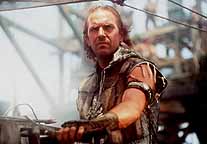
Remember that really bad Kevin Costner film, “Waterworld”?


It seems our near future (i.e., 100 to 200 years) might include some of the basis for that film, hopefully without the bad acting. This from the Guardian, via HuffingtonPost:

New studies of Greenland and Antarctica have forced a UN expert panel to conclude there is a 50% chance that widespread ice sheet loss "may no longer be avoided" because of greenhouse gases in the atmosphere.

Such melting would raise sea levels by four to six metres, the scientists say. It would cause "major changes in coastline and inundation of low-lying areas" and require "costly and challenging" efforts to move millions of people and infrastructure from vulnerable areas. The previous official line, issued in 2001, was that the chance of such an event was "not well known, but probably very low".
The melting process could take centuries, but increased warming caused by a failure to cut emissions would accelerate the ice sheets' demise, and give nations less time to adapt to the consequences. Areas such as the Maldives would be swamped and low-lying countries such as the Netherlands and Bangladesh, as well as coastal cities including London, New York and Tokyo, would face critical flooding.

The warning appears in a report from the Intergovernmental Panel on Climate Change, which assesses the likely impacts of global warming and will be published in April. A final draft of the report's summary-for-policymakers chapter, obtained by the Guardian, says: "Very large sea level rises that would result from widespread deglaciation of Greenland and West Antarctic ice sheets imply major changes in coastlines and inundation of low-lying areas, with greatest effects in river deltas.

"Relocating populations, economic activity and infrastructure would be costly and challenging. There is medium confidence that both ice sheets would be committed to partial deglaciation for a global average temperature increase greater than 1-2C, causing sea level rise of 4-6m over centuries to millennia." Medium confidence means about a five in 10 chance.


What’s really scary about this prediction is that the influx of so much freshwater would likely interrupt the oceans currents. Fresh water and salt water do not readily mix, and therefore the fresh water would set up a boundary between the two. The normal circular current rotations where the warmer salt water rises, moves around, cools and then sinks would not work anymore. If this were to happen, we could be seeing much larger climatic changes than just rising sea levels and inundated coastal cities. (Which, incidently, was the subject of another forgettable Hollywood film, "The Day After Tomorrow". Those whacky, reactionary Hollywood types, always making goofy movies out of probable events.)

Personally, I had been hoping that the human race would run out of cheap energy before we inflicted huge damage on our home planet of Earth. However, that seems to be no longer the case. It appears as if these two things are going to occur simultaneously. I predict it will not be pretty. Our food production and distribution system will likely fall apart right at the time that massive population relocation is going to have to occur. Very selfishly, I guess I am glad that I will not likely be around to see the worst of it. Our children’s children may have a very hard time of it, though. I certainly hope I am wrong, but I cannot see another conclusion that is more logical.

What the world needs right now is for a “Manhattan-type project” on a global scale to find ways of immediately reducing our greenhouse gas output, finding new energy sources that will replace all petroleum and coal based sources, and figure out a way to cope with the likely changes that will result in the next 100 years. However, I have absolutely no hope that this will ever happen. Our society is pretty good at coping, but only AFTER a disaster has happened. We do not seem to be able to deal with things proactively, even when our very existence, as we now know it, may be at stake.

Thursday, February 15, 2007

As Will Rogers once said, “Everyone talks about the weather, but nobody ever does anything about it.”


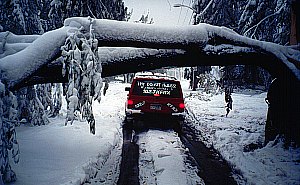
These last few years seem to have provided, and are still in the process of providing, pretty massive and dramatic weather patterns. We’ve just experienced deadly tornadoes in February in Louisiana and Florida, and huge snowstorms in the Midwest and East Coast after record warm temperatures. After the vicious year of a record number of Category 3, 4 and 5 hurricanes two summers ago, we then had hardly any the next year, with none of them making landfall in the United States. Here in the Pacific Northwest, we just experienced a very dramatic end of autumn/beginning of winter, with record warm temperatures, followed by torrential rain which spawned localized but sever flooding, followed by gale-to-hurricane strength windstorms which ripped down trees and power lines, followed by multiple snow events. Just in my short history here, I can see that this was a very unusual period of weather for us, which is normally just sort of gray, damp and dark.

Scientists cannot agree on a scientific basis by which these dramatic weather events could be directly contributed to global warming. However, there does seem to be a consensus that, whatever is going on, short term or long term, human activity seems to be making things worse. On a global scale, things usually change so slowly that humans are not even aware they are occurring. However, when something DOES happen which we can see, like an increase in the temperature of the oceans or the loss of massive ice shelves in Canada and Greenland, we can definitely say something is going on at a rather rapid pace (geologically speaking).

It seems to me that we should all get used to the unusual, when it comes to the weather. The Earth has been experiencing what scientists are saying is a rather prolonged period of very stable climate. We may be entering into a new period where “unsettled and dramatic” is the new norm. What this may mean for the next several hundred years is still being determined. However, in the short term, I would suggest that people have their insurance paid up, including flood insurance, cut down all the very large trees within reach of your house if they topple over and keep a snow shovel handy. It could be a very bumpy ride.

Thursday, February 08, 2007

Why Fundamentalist Christians Hate Science. (Or, “Oh, dearie me. Whatever shall we do about all these pesky dinosaurs?”)


Not that this question is much of a mystery. The problem with science, and all logical thought processes for that matter, for Fundamentalist Christians is that the conclusions reached undercut some of the basic tenets upon which Christian dogma depends. This has been true for thousands of years, and will continue to be true. The problem, for Christians, is this. In their view of the universe, everything related to their faith is the Absolute Truth. The Absolute Truth can never change. It can never be wrong. It is inviolable. For them, if anything within their belief system is shown to be incorrect, then that, apparently, calls into question their entire belief system!

If the Absolute Truth happens to be written down, say, in a book called The Bible, then it becomes especially difficult to reconcile when facts start intruding upon The Truth. Written words are not as easily discounted and forgotten as verbal mythology. Therefore, in order for Fundamentalist Christians to avoid complete anarchy in their belief system, every single word in the Bible must be defended to the death, even when it means trying to explain away some very inconvenient and uncomfortable facts.

I find that kind of thinking incomprehensible. But yet, this kind of thinking leads people to declare such absurdities like the following:

- Dinosaurs lived at the same time as man, and were carried by Noah on the Ark.
- Dinosaurs are probably alive today, we just don’t know where to look for them. (Yes, I agree, they are. Look in your backyard. They’re called “birds”.)
- Carnivorous dinosaurs had long, sharp, curved teeth to strip bark off of trees, because all animals, including carnivorous dinosaurs, were vegetarians prior to Adam and Eve being tossed out of the Garden of Eden.

I do not understand the Fundamentalist Christians’ obsession of late with dinosaurs. I suppose they finally came to the realization that they could not ignore the overwhelming evidence that dinosaurs once lived but are not around now. They just can’t explain away all those huge skeletons in museums around the world, so they just did their best in incorporating the past existence of dinosaurs into the belief system, intact, such that they didn’t have any pesky contradictions or loose ends regarding dinosaurs lying around.

One big problem with this approach, however, is that there are now a lot more scientific facts that would cause any rational person to doubt these assertions. For one thing, all of the geologic evidence and the fossil record show that these assertions to be complete nonsense. However, given the huge investment the Fundamentalist Christians have in defending their belief system from any and all inconvenient facts, they do what they do best; attack the messengers and say that all facts which don’t coincide with their world view are incorrect.

What the Fundamentalist Christians are doing here is just as blatant as if they were refuting the existence of dinosaur fossils. The only difference is that a big honking T. Rex skeleton staring down at you is pretty hard to ignore. The geological record is easier to ignore than the T. Rex. It involves actually understanding the subject, doing research, and coming to logical conclusions based on empirical evidence. So, rather than try to incorporate the contradictory evidence presented by the geological record into the belief system, the Fundamentalist Christians just say that scientists are wrong. Their proof? Their initial, totally unsupported postulation that, because the Bible contains only the Absolute Truth, anything that contradicts it must be incorrect. Therefore, if their initial argument is already accepted as the Absolute Truth, then the geological record must be wrong. Pretty neat trick, eh? The flip side of this approach is, anything that you say in support of the Absolute Truth automatically becomes part of the Absolute Truth.

(As an aside, I would really like a Fundamentalist Christian to try to explain Neanderthals. There is overwhelming evidence that cannot be refuted that they existed in Europe and the Middle East for thousands of years. Another fact that cannot be refuted is that Neanderthals were not humans. They were certainly related to us, but the bone structure makes it obvious that they were not us. However, it is easier for Fundamentalist Christians to ignore their existence, and instead focus on hoaxes such as the Piltdown Man, so they can say what idiots all scientists are. And who proved the Piltdown Man was a hoax? Scientists. I’m just saying.)

This entire discussion reminds me so much of how the Church reacted to Galileo’s theory that the sun did not revolve around the Earth, and therefore, the Earth was not (as the Fundamentalist Christians’ view back in the 1600’s maintained) at the center of the Universe. This was heresy in the eyes of the Church. In the eyes of the powerful Church elders, if this were true, then everything else they believed in also comes into question.

It’s funny how a few hundred years change people’s perceptions and beliefs. Back then, what Galileo was proposing threatened to undermine the entire basis of Fundamentalist Christian teachings. Now, due to the overwhelming evidence supporting Galileo’s proposal, everyone accepts the fact that the Earth indeed revolves around the sun and is, in actuality, a very small speck in the fabric of the universe. Has this new adjustment in thinking changed how the Fundamentalist Christians view the Absolute Truth? No, it has not. It has been incorporated into their paradigm. If anyone happens to dwell too deeply on why God might be so fixated on goings-on that occur on the Earth in the vastness of the cosmos, they are quickly hushed. But the entire concept now presents no insurmountable obstacles that stand in the way of the literal interpretation of the Bible.

The most ironic thing I find about the logical contortions that the Fundamentalist Christians go through is that they feel, somehow, that scientists are trying to disprove the existence of God. I have seen this in print several times. In my mind, nothing can be further from the truth. The basic reason that scientists probe the unknown is to try to figure out how the universe, and everything that it contains, works. It has nothing at all to do with the existence or non-existence of God. Why galaxies exist, what is the nature of sub-atomics particles, what killed off the dinosaurs, is there a way to predict earthquakes, all are questions being probed by science in one way or another. If a belief system desires to postulate that a Supreme Being is responsible for the existence of the universe and that all events within the universe are predetermined, the very nature of that postulation cannot be shown to be true or false by scientific evidence. It is a purely a matter of belief and is therefore not subject to scientific scrutiny.

What is open to scrutiny is when religion makes assertions about the physical nature of the universe. Science can, and does, make inquiries into the validity of these assertions. In many cases, religious assertions about the nature of the universe to not stand up to the bright light of inspection. But here is where I disagree with the Fundamentalist Christians’ conclusions. By disproving certain religious assertions about the nature of the universe, science isnot attempting to disprove the spiritual assertions of a religion. That is not the point. I would disagree with any scientist who is asserting that is what he or she is trying to do. Spiritual matters are not the purview of science. No matter my particular feeling toward organized, strictly interpreted religions in general, I will state that is should not be the business of science to try to prove something which cannot be observed or measured directly, and therefore, is outside the normal bounds of scientific inquiry.

However, Fundamentalist Christians have arrived at the opposite conclusion. In their minds, any inquiry into the nature of things that might possibly arrive at a different conclusion than what their personal belief system subscribes to is automatically taken as an attack against that religious belief system. Therefore, they must attack back, because scientists are “attacking them first”. This is, to put it politely, an immense load of cow flop. Yet, it seems to be the one and only thing that is holding the Fundamentalist Christian thought processes together. Circle the wagons, fight back, and never ask any introspective questions or entertain a moment of self-doubt during a time when your survival is under attack from a group of outsiders.

I cannot fathom this kind of thinking that actively tries to subvert, invalidate or ignore scientific inquiry. That is one thing, among many, that makes us humans. We constantly question what is the nature of the universe and how, as human beings, do we relate to that universe. I, for one, am proud to live in a time where we understand the basic structure of the universe. We have sent a space probe through the rings of Saturn and dropped probes on Titan and multiple rovers on Mars. We have concrete evidence that water, lots of water, once flowed freely on Mars. Within the next few years, we should have pictures of Pluto and its’ moon/twin planetoid Charon. We are probing the nature of matter down to the subatomic level. The universe is a wild, wonderful, amazing place that constantly surprises us. New, amazing discoveries are being made in all branches of science every day. Why should anyone consciously decide to close their eyes and ears to this, just because they feel the need to adhere to an unquestioning belief in a very old and oft-edited book whose origins are, at best, unclear?

I just do not understand willful ignorance.

Sunday, February 04, 2007

“It Can’t Happen Here”


That’s the title of a book I am currently reading. I have had it in my library for a while, but haven’t gotten around to reading it. It was written in 1935 by Sinclair Lewis, author of “Arrowsmith” and “Elmer Gantry”. I am about a third of the way through it. It is about, to put it bluntly, the takeover of the American government by ideologues and the installation of a fascist government, from the point of view of a small town newspaper editor, his daughter, and several friends who have not been swept up in the frenzy.

I am rather vague about American history in 1936. American was still in the Great Depression. Franklin D. Roosevelt was the incumbent president and was reelected. This book is similar to several other “alterative history” works of fiction I have read, where history diverges from a known starting point and proceeds down a new path. In this book, a new politician with the unlikely name of Berzelius Windrip springs from nowhere to capture America’s imagination, mostly by promising anything and everything to everybody, including $5000 (which was a substantial sum in 1936) to every working family. Given the sometimes dark and disturbing history of this nation, and the fact that it takes place in the Depression when hope and money was in short supply, it doesn’t take a lot of imagination to see how this person could be elected instead of Roosevelt.

The underlying message of this work is, and is reflected in the title, that ordinary people can be swept up by the passion of a person or group with an agenda that gets enough momentum going, and everyone else might be concerned but not terribly worried, because things like that just “can’t happen here”.

The reason I decided to read this was, of course, the parallels to our current situation. I have been concerned for some time that we seemed to be recklessly heading down a path to a fascist theocratic state, and not very many people seemed to be aware of the danger of this country becoming something totally different than what it has been in the past. George Bush, along with his brains, Karl Rove, succeeded in putting together a political machine that essentially hijacked another, more established and much larger, political machine in the Republican party. There can be much debate as to how far the Republicans had gone down this road already before Bush showed up. He may have just been the tipping point: the right person at the right time. However we got here, the Republican Party is no longer the party of smaller, less intrusive government and fiscal restraint and responsibility. It is a party devoted to the ideals of overarching government, unrestrained power of the Executive branch, stacking the Judiciary with true believers, redistribution of wealth toward the top end of the pyramid, graft, corruption, lying to the people whenever it forwards their agenda, and a very powerful military that is capable of never ending war.

The plot, at times, is somewhat “heavy handed” and there are differences when comparing it to today. One big one is that Windrip gets the nomination for President from the Democratic Party, knocking out Roosevelt at the convention. Windrip speaks to the “forgotten men”, the workers, the miners, the unemployed, and the disaffected. That is certainly not how our current situation developed. However, it is quite apparent that Windrip never intended to follow through on any of his promises, including the $5000 per family that was the basis of his campaign. Once elected, there was no more need to pretend. He instantly installed a fascist type government, complete with his own private army of “blue shirts” that quashed any sort of protest immediately and without mercy.

However, these difference aside, it is eerie how “spot on” this book is regarding our current situation. Lewis is as prescient in the political realm as Jules Verne or H.G. Wells was in the realm of science. There was a “man behind the man” in the form of an advisor, who really ran things and even went so far as to author a book that was published under the name of his boss. The physical attributes of the two men are very different, but it is impossible to not recognize the character of Karl Rove. Windrip was elected with the help of the fundamentalist Christians, when a newly conceived “radio evangelist” threw his endorsement behind Windrip. The evangelistic character was subsequently arrested immediately after the inauguration, which could be considered to be how disdainful Bush and his minions are of the fundamentalists once they get their votes. One of the main planks in Windrip’s platform is to alter the Constitution such that Congress can only act in an advisory capacity. It can offer no real restraint to the power of the Presidency. The Judiciary is emasculated, such that it cannot issue any judgments on the edicts of the President. And, of course, there is the capacity to wage war. War is seen as something that will stimulate the economy. It will put “backbone” back into the country, which has become weak and effeminate.

There are many other similarities that have jolted me while reading “It Can’t Happen Here”. I am anxious to get to the place where the country really becomes a fascist state, just to see how bad Lewis’s predictions are. His basic message is, of course, you are absolutely fooling yourself if you don’t think it could happen here. Here is one, somewhat plausible, scenario that could have occurred in 1936. We have just been witness to another, plausible because it was happening in front of our very eyes, scenario that could (and still might) lead this country into morphing into a very ugly specter of what it once was. We need to be on our guard at all times, as our democratic system can be hijacked my merciless people with an agenda who will do or say anything to get elected and, once elected, will do anything to stay in power.

I am only hoping that the country is finally waking up to what has truly been transpiring behind the curtains over the last six years. I recommend that everyone in the country should get a refresher course in history and, if they can turn off the television when “American Idol” is on, read this fictional account of what can happen when emotions overcome logic and rational thinking.

Thursday, February 01, 2007

Modern society vs. scientific thinking


I started this blog because I was very upset with how the Bush, along with his willing partners, the GOP controlled Congress and the lapdog media, were driving this country into the ground. I was, and remain, very annoyed with our society, the elevation of the trivial into something that captivates the national consciousness while really important items are ignored or marginalized. From five steps back, our society is bordering on being psychotic.

My problem with trying to write about all of this is the fact that I am not, and have never been, truly involved in politics. I did not major in human psychology or sociology. I do not have the time to devote to these subjects to become truly insightful. I just stand back and make observations that any reasonably intelligent and half awake person might make. And most of them do it much better than I. Check out the links over at the right hand column.

I think those are the primary reasons why my enthusiasm for writing a daily blog has waned since the elections.

However, there are some things I do know about. I have degrees in engineering and physics. I have been trained as a scientist and engineer, both of which demand a certain amount of discipline in how a person observes problems and formulates conclusions. Therefore, I thought I might try some posts involving some scientific angle. That is an area that I think I can talk with some amount of certitude.

Getting back to an actual subject.... Opinions are NOT the same thing as facts, and turning up the volume, sarcasm, or rancor is going to turn opinion into facts. This is perhaps the biggest thing that has upset me about the road our society is going down. Everyone is doing it. Religious fundamentalists, politicians, television and newspaper opinionators, citizens with an agenda, all have fallen prey to this. And because it has become so prevalent, hardly anyone even notices it happening anymore. No one (that anyone pays attention to, anyway) ever calls “Bullshit!” when this happens. This is how we got stampeded into a totally unnecessary war by a bunch of sour old white guys with an agenda. This is why we are facing, in the next 100 years, a very catastrophic period of climate change and very unforgiving weather patterns that will not be very kind to the survival of the human race. And most people would either like to just pretend either one of two things; it isn’t going to happen or it is some sort of liberal plot. Just what kind of plot and what the plotters might like to accomplish is yet to be explained.

My perception is that non-scientific people have always looked at scientists and engineers with a mixed sense of bemusement, irritation, and suspicion. Quite often, laypeople have a difficult time in figuring out what some of the more esoteric branches of science are actually on about. Discussions of bosons, quarks, and mu-mesons can cause anyone’s eyes to glaze over very quickly. People wonder why our tax dollars are being spent in pursuit of arcane knowledge that does not seem as it will be useful to anyone. Massively expensive projects such as the Hubble space telescope or the various planetary explorers are only tolerated because they produce such beautiful and tangible results that cannot be ignored. However, to the general public, superconducting particle accelerators are about as useful and relevant as Stonehenge.

Because some aspects of science are not readily understandable or even logical, people feel quite comfortable in labeling ALL science and scientists as irrelevant at best, crackpots at worst. When scientific results conflict with a basic political or theological “notion”, then it becomes time to declare war on the messengers. Luckily, there are ready and willing public media outlets who are quit willing to do the character assassination, if the politicians in charge don’t beat them to the punch.

One big problem is, of course, that most people want to be able to dismiss uncomfortable conclusions that the many branches of science provide. People, for the most part, do not want to be challenged or to be made to rethink some preciously held beliefs. Religious fundamentalists want to believe that the Earth is 6000 years old and dinosaurs and man lived together at the same time. Political conservatives want to believe that global warming and the looming climate change is a myth. This is very unsettling to me, that people can just dismiss facts, documented research, hard evidence and logical conclusions so easily. As Mr. Spock was so fond of saying, “That is not logical.”

That is not the part of the problem that I am going to discuss here. I might take that one on later, but here is what I want to talk about now. Most people in today’s society are totally ignorant about science and the scientific method. Keep in mind that the word “ignorant” is not the same as “stupid”. There are many, many very intelligent people out there who, for one reason or another, have decided that facts and opinion are pretty much the same thing. The correct word is “ignorant”, whose base word is, of course, “ignore”. Either through no fault of their own, or through willingness, they are devoid of any knowledge about a certain subject. This has helped the vast majority of the population of the United States relegate science and the scientific method to total irrelevance. The following is my little effort in trying to reverse this trend in society, even though it seems like trying to hold back a tsunami with a parasol.

The scientific method is the bedrock that the worldwide scientific community uses for their investigations and results. One big “criticism” that laymen with an agenda have for science is that they get to say “Oh, it’s only a theory.” What they fail to realize when they say that is EVERYTHING is “only a theory”. The theory of evolution is just as much a theory as is Einstein’s theory of relativity. The big questions about any theory are, how many of the outstanding questions about any particular subject does that theory answer and how many peers agree with theory? Peer review of any scientific investigation and subsequent conclusion(s) are vital. Scientists make mistakes. Scientists have vested interests in “proving” that their theory is the correct one. Scientists also, unfortunately, sometimes have agendas. It’s up to their peers to discover the validity of their work.

Everything in the process starts with facts that everyone can easily agree to. These can be easily observable phenomena or objects, or scientific conclusions that have become generally accepted as valid. (Please note that I did not say “the truth”. Truth is very subjective in science.) Using these facts as a jumping off point, the scientist or researcher uses logic backed up, when necessary, by other facts to come to some sort of conclusion. Results are usually published or presented in front of a conference, where peers get to review the entire process and make their input. Usually, if some flaw in the chain has occurred, such as a breakdown of the logical building blocks on which the conclusion is based or even a disagreement upon the fundamental “facts”, a peer review will uncover it very quickly.

One easily remembered example of this is the “discovery” of cold-fusion. Two scientists say that they had achieved cold-fusion (the combining of matter at an atomic level) without massive amounts of heat. “Fusion in a drinking cup”, in other words. There was great excitement in the press when this was first announced in the late 1980’s, and lots of immediate skepticism by other scientists. Very quickly, the whole notion was dismissed, as the scientists experimental method and conclusions were shown to be flawed.

That is the entire process. You start with known facts and, using logic, math, and other additional facts, you arrive at a conclusion to explain these facts. By an iterative process, these conclusions become more and more refined and, as a result, answer more and more of the unknown questions that people want answers to. As these results “solidify”, then more and more people start accepting the theorized result as a “fact”.

The most important aspect of this process it is never static. At any time, when new facts become available, older, accepted facts can become subject to a renewed investigation and a new theory may be substituted for the old. The classic example is how Newtonian physics was the accepted model for hundreds of years of how the universe operates. However, when Einstein and other physicists really got examining planetary motions, it became obvious that Newton’s model, although adequate to explain much of what can be observed, totally breaks down when you take a closer look. Hence, Einstein’s model became the new, accepted “theory”, until other scientists and mathematicians such as Stephen Hawking showed that there were holes in Einstein’s theory as well.

The process never stops. Theories are constantly being updated, refined, and sometimes, shown to be totally incorrect. When this occurs, the process starts over again. That is why this all works.

Many times, the entire process is not as ‘cut and dried’ as people would like. Results are vague or ambiguous. Initial “facts” can be interpreted differently by different people, such that when the scientific process is followed, different results occur. Disagreements, sometimes very emotional and personal, can break out between scientists or scientific communities, over these differences. However, even though there are these disagreements (e.g, was the Tyrannosaurus Rex a predator or a scavenger?) will always be part of the scientific debate, there is no disagreement about the goal of the process. That is, what theory can we put forward that best addresses the unknown questions that is based on solid observable or analytical facts and a logical argument that can be accepted and replicated by the scientific community?

This is where, I believe, that the layperson gets lost with science. Not only are some of the conclusions reached very difficult to grasp and downright illogical at times, but most people do not seem to feel very comfortable with the concept that ‘the truth’ is not some sacrosanct, inviolable thing that can never be questioned. They do not like that ‘the truth’ can change overnight. When one firmly believes in something, like the literal interpretation of the Bible where every single word in that book comes from God and is therefore ‘the truth and the only truth’, it is very disturbing to discover that scientists routinely go back and challenge generally accepted notions. If someone can do that, then it wasn’t ‘the truth’ to begin with. It is ‘only a theory’, which therefore, cannot be ‘the truth’. And if that is true, then my opinion is quite as good or even better than your ‘facts’, since your facts can change but my opinion never will!

In many ways, our society hasn’t advanced greatly since Medieval times. Oh, we have much better tools and we hardly have to lift a finger to have quite a comfortable lifestyle. Ruefully, we have much better weapons these days. But the great majority of us would just as soon choose to live our lives in willful ignorance and never challenge ourselves. We want the universe to be knowable, understandable, and most importantly, conform to and confirm our dearly held opinions.

That, to me, is a sure way for our society to slide backwards into ignorance. The Chinese and other societies who are not so afraid of the unknown will pass us by in very short order. The only thing that is saving us right now is the incredible inertia our society has built up. However, even the mighty civilizations of Rome, Greece, and Egypt slowly decayed and become irrelevant. That is where I think our country is heading.