Showing posts with label technology. Show all posts

Tuesday, October 02, 2012

Huge new wind turbine in work from Siemens.


From Gizmag.com

Siemens has released pictures of its truly gargantuan B75 wind turbine rotor blades. As you might imagine, the prototype turbines that will use these blades boast some staggering statistics of their own (Airbuses at the ready, please).

Remarkably, the 75-meter-long (246-ft) blades consist of a single component made from epoxy resin and balsa reinforced with glass fiber, cast in a gigantic mold using a process Siemens has cunningly named IntegralBlade.


Initially, three B75 blades will be put to use in a prototype 6-MW offshore turbine at Denmark's national test center at Østerild. The sweep of the completed turbine will cover 18,600 sq m (200,200 sq ft) and the tips of the blades will move at 290 km/h (180 mph) at full lick. At a wind speed of 10 m/s (19.4 knots), the turbine will be hit by 200 tons (181 metric tonnes) of air every second.

The blade length of 75 m is not a kick-in-the-pants off the wingspan of an Airbus A380 (at 79.75 m or 261.6 ft), meaning that in a Y-position, the airliner could easily pass within the 154-meter (505-ft) sweep's radius above the blades (spatially at least. In practice this isn't recommended).


Siemens has already seen 6-MW turbines installed at the UK's Gunfleet Sands wind farm, albeit with 60-m (197-ft) blades. Thanks to a process Siemens has branded "QuantumBlade," it claims the B75s weigh four fifths of conventional blades. "The weight reduction is achieved by using specially designed blade profiles that are also shaped in a way that delivers maximum rotor performance at a range of different wind speeds," the company says.

Friday, January 27, 2012

Upon reading an anthology of stories by H.P. Lovecraft, or why I will never, ever own a Kindle.


Artistic rendering of Cthulhu, which also sort of represents my feeling towards complex electronic devices in general.

Yes, I recognize the fact that I am somewhat of a technophobe. Anything more complex than a ratcheting socket wrench usually ends up not working for me. Computers do not work. Wireless connections do not work. OK, my cell phone usually works, but that seems to be an exception, probably because it is one of the very low end devices that really does not do anything other than make and receive phone calls and text messages. I will never own a “smart phone.” I absolutely hate crap that doesn't work for me and I have to spend more time figuring out how to make them work correctly than the time I want to use them for.

So, I know that I am already predisposed not to be very enamored of a Kindle or other similar “electronic book” device. But here are some thoughts about why real books – for me, in any case – are vastly superior to a Kindle.

As the title states, I just finished reading an anthology by the great horror writer, H.P. Lovecraft. Click the link if you don’t know who he is. I realize that some younger folks in America might not have a clue as to the influence Howard Phillips Lovecraft had on American horror, and still exerts to this day. Horror writers such as Stephen King freely acknowledge Lovecraft’s influence on their own work. Films such as the Nightmare on Elm Street franchise, many films by John Carpenter such as “The Thing,” probably all of the films by Wes Craven, etc. etc. owe their existence to the work of Lovecraft.

That doesn’t do a lot to explain my love of real books over a Kindle, other than to set the stage. I picked up my Lovecraft anthology in a used bookstore (absolutely the best kind of bookstore) for seven bucks a few weeks ago. This particular one was printed in 1945. The cover is in pretty good shape for something that old, although the top of the spine is pretty frayed looking and the corners are rather smashed with the cardboard sticking through the cloth covering. The pages are all very yellow, especially around the edges, as are many books that were printed during the war years of the 1940’s when they used much cheaper paper with a higher acid content than normal. There are water stains on the edges and the book has this very “old book-ish” smell to it. In other words, it is an absolutely perfect vehicle from which to read a little Lovecraft. In case I have whetted your interest, you might go looking for a version of “The Colour Out of Space.” That might be the most frightening short story I have ever read. I remember reading it when I was in jr. high school, probably at 11 o’clock at night. It made quite an impact. “The Cult of Cthulhu” is also a very good read, and is probably his most famous story. I just could not envision reading something like that from an electronic reader, where you are just scrolling up and down an LED powered screen. Where are the browning pages? Where is that interesting smell? An e-book would just not have worked for me.

I just like books as the means to deliver the words to the reader. Books have a substance to them that a Kindle could never have. Books, especially older books that have been read many times, develop a character all their own. They become unlike the next book you pick up off the shelf. I even love paperback books. I enjoy flipping back and forth between pages when I am taking a break from actual reading, which I do rather often. I go back and look at the cover art. My, isn’t that an interesting piece of artwork? I contemplate the creases in the spine and the missing chips from the cover. The more dog-eared the copy, the better. One book that I have that I re-read about every other year is “The Magus” by John Fowles. I won’t go into a literary discussion of that particular novel at this time. Many people don’t like it; as it sometimes seems to be an exercise in the worst excesses of that particular writing style, “Let’s try to confuse the hell out of the reader.” But I somehow find it fascinating. It just has a very unique, mysterious air to it, even when I know what is coming. My original copy of that book split into two pieces because of multiple readings and admittedly less than careful handling. I put lots of Elmer’s glue on the outside of the spine and then several layers of Scotch tape. That worked fine and it gives a very unique feeling to the book. I know exactly which book from my collection I am holding when I have that in my hand.

Yes, I am somewhat of a collector of old books, which also no doubt colors my perception of a Kindle. I have a number of very interesting editions, such as a what appears to be a first edition from 1901 of “Mr. Munchausen,” from spawned several films over the years, including Terry Gilliam’s “The Adventures of Baron Munchausen,” and a 1894 first edition of “Trilby,” which gave us the evil manipulator, Svengali, and popularized the notion of “animal magnetism,” also known as hypnotism. I could go on, as I have quite a number of interesting volumes in my collection. I just don’t see the attraction of reading any of those books on a Kindle device. Any book that I would read purely for enjoyment, I really want that book. I may get rid of it later, but I want to hold that copy in my hand while I am reading it. Being able to download it from Amazon for a couple of bucks instantaneously holds no attraction for me.

Now, this is not to say that I think that the Kindle should not exist. I have heard a number of stories about how someone’s mother has started reading again, mostly because of the ease of use and the fact that you can make the font really big for someone who would otherwise have to strain to read smaller print. Great. Maybe it would be good for a collection of technical books as well, although I still like being able to flip back and forth between pages, where you can easily see where you are in the volume, rather than try to scroll around or jump around between pages. I have enough of that with these technical documents I have to read on the computer for my job. And I can see where a search function would come in really handy from time to time. But I grew up with books. My mom had lots of books lying around. She read to me from some very old copies of “Winnie the Pooh.” I avidly read all the Hardy Boy books when I was a kid. I have always had a large collection of books that has followed me to place to place as I moved around during my life. When I remodeled my house, I specifically included a largish library/computer room with two walls covered with built-in bookshelves, which were filled immediately when I unloaded all the boxes that contained my books.

Carrying around an electronic tablet thingy that probably wouldn’t work the way I wanted it to and the battery would run out when I needed it and didn’t have the recharger just wouldn’t cut it for me.

Friday, October 28, 2011

Science moment of the day: Jupiter's Great Red Spot


Wow. That's about all the narrative necessary for this one. Just, wow....

Snapped from the New Horizons spacecraft on its way to Saturn.

Photo from NASA. Click on the photo for a (slightly) enlarged version.

Tuesday, June 28, 2011

And while I am at it, I detest Comcast as well.

I've been dealing with a "hi speed internet" connection problem on my home network that has been getting progressively worse. It's now to the point that, at many times, it's no better than a dial up connection. Bad, in other words. Bad and slow. So, I finally work up the energy to call Comcast, because I know it is going to be an ordeal. I sit through their damn automated menu system and push the right buttons, and I finally do get someone to talk to. Lo and behold, this is actually a nice, seemingly helpful person who wants to help me with my problem. Looks to me to be a bad wireless router. If the computers are right next to it, everything is fine. You get 40 feet from it, and things barely work at all. OK, I think I need a new router. After all, this is Comcast's property, they are "leasing" it to me or something. It's their equipment. Finally, the guy on the phone transfers me to someone else called "Xfinity Signature Support." I figure it's now their arm that supports the high speed internet stuff. After talking with this nice, helpful lady for about 10 minutes, I finally figure out that she is attempting to SELL me a support package, which I will have to pay about 20 bucks a month and a one-time sign up fee of $79. All to fix a problem with a service (high speed internet) that I am already paying for from Comcast, that doesn't work, and I want them to fix it. That's all. I am buying something from them that doesn't work. I want it to work. And they send me to some other "fee for service" part of their company that wants to sell me a 20 buck a month, plus a sign up fee, to fix something that doesn't work!

FU, Comcast. Jesus Christ, what happened to a customer focus in American business? Can't they do ANYTHING without trying to soak their customers just a little bit more? Goddamn..... Once I get my energy back, I am going to call back Comcast, and sit through their stupid automated phone menu that takes five minutes before you get to actually talk to a person, and demand someone come out and fix this without requiring me to sign up for some sort of "Signature Service."

The American business mentality sucks so bad. All they can do is think about how to make more money.

Yet another reason to hate Apple, Macs, and everything "i" related.

I have spent the last half hour trying to get iTunes on my Mac to play some of my old CD's. It appears that if a new disc gets put in the computer that it hasn't seen before, iTunes goes and "queries" some database about the CD. I guess it is trying to get the name and all the songs and other info that iTunes likes to put into it's information. But apparently either there is some problem about contacting that database or else maybe the database doesn't know about these discs. It refuses to play almost every CD I put in. Nope, I don't know what that is, so I am not going to play it. I didn't know this, but there is not a PLAY CD command anywhere. Not until the CD gets a thumbs up from this database.... Oh, I did get it to play Revolver from the Beatles. I guess it knows who the Beatles are. It doesn't like Firefall, or any of the "new age" instrumental music I have from the 80's. It just won't play them.

I can't express how much I detest working with computers which were designed by people who think that they know everything and limit, on purpose, what the user can do.

I am about ready to pitch this stupid Mac out the window. And that is the entire reason I went with a Mac in the first place, because I hated my PC.

Saturday, March 26, 2011

I am starting to have this same feeling of unreality about the Japanese nuclear disaster that I did about the oil spill in the Gulf.

This is a very serious situation and I believe that we don’t know half of what is going on. Here is a short description via DailyKos about what the people on the ground are dealing with.

The world today got its first glance of the 50 workers, until now an anonymous group of lower and mid-level managers. Pictures from inside the plant show staff in full protective suits and masks working in debris-strewn control rooms lit only by torchlight. They are also pictured working to reconnect power supplies and trying to make the towers in the plant safe.

Five are believed to have died and 15 are injured while others have said they know the radiation will kill them. At first light today officials were alarmed to see steam pouring from reactors 1, 2, 3, and 4. It was the first time that steam has escaped from the No 1 reactor.


I have heard about the two or three workers that got radiation burns on their feet and legs by walking in radioactive water. But this is the first time I have heard about people actually dying and receiving enough radiation to know that they are going to die. I also did not understand the true devastation because of the hydrogen explosions. The controlling mechanisms, even if they get electrical power restored, may not actually function. And we are now hearing that one of the main containment vessels has a very large crack in it and that was probably the source of the radioactive water that burned the workers as they valiantly attempted to do whatever they could to help the situation.

Remember, also, that these plants are on the shoreline of the ocean. All this radioactive runoff is going directly into the ocean.

I know this is poor taste and I think many people have been avoiding making these comparisons just for that reason. But I can’t help but notice that the situation now resembles many of the mutant monster sci-fi films of the 1950’s, both Japanese and American. No, I don’t expect a giant whatsits to come lumbering out of the sea and start crushing cars. The giant monsters were just metaphors anyway. The real monster, the unknown entity that we were all totally unprepared to deal with, is radioactivity. The only real differences here are the fact that an earthquake and tsunami were act the heart of the disaster, not an atomic bomb. Otherwise, those filmmakers were very prescient.

I keep hoping that this will all just go away. The situation can’t possible be as dire as I am thinking it might be. I was having some pretty awful thoughts about not being able to cap an oil gusher at the bottom of the Gulf of Mexico. The situation in Japan is much, much worse. I really don’t even want to consider the possibility of the “worst-case scenario.”

Tuesday, March 22, 2011

Technology: Does the Japanese nuclear reactor crisis indicate we have become far too trusting of technology?

Before I start on this, I need to explain something. I do know something about this subject on which I am about to expound. I have a job involved in very complex technology. I can’t write about those direct experiences, however. One of my firm rules I imposed upon myself when I started this blog was that I wasn’t going to blog about my job. That is a good way to lose said job. But I do have almost 30 years experience with dealing with safety critical, highly complex systems. You are going to have to trust me on that point. And, for the record, I have a Bachelor’s degree in electrical engineering and a Master’s in physics. While I was in college, I also received some experience in the power generation field and spent some time around a nuclear power plant, courtesy of my participating in the school’s cooperative education program. Although that was now over 30 years ago, I do remember quite a lot of the fundamentals involved here.

For the record, no, I don’t work in the power generation field with my current job.

I have been watching with interest the ongoing and continually worsening crisis in Japan regarding the four (I believe it is now four, it could be more) unstable, possibly out of control, nuclear reactors in Japan. This emergency has been ongoing since the double barrel hit of a magnitude 9.0 earthquake and a huge tsunami, and it seems to be getting worse as the days progress. I am not going to try to summarize the current situation, as any summary I try to put together will be out of date by tomorrow. Rather, I would like to focus on the bigger issue of technology in general and how our society has become totally dependent upon it without understanding or underestimating the very real risks involved.


I have seen some writers in recent days compare this accident, if that is even a good word for it, to the sinking of the Titanic in 1912. That ship was labeled, from the time it was on the drawing board, as “unsinkable.” Literally, the belief was that it could never be sunk. Technology had advanced during the Industrial Age to the point that it was infallible. That was one reason why, when that huge ship sank on its very first voyage, it just clobbered the accepted reality of the day. Yes, the horrendous loss of life also had a huge impact on the collective psyches of both America and Britain. But the one part that I would like to discuss is the fact that people really had come to believe that the technology involved was that advanced such that all risks had been negated. That ship could never sink, end of story.

Our society today seems to find itself in that same erroneous state of mind regarding technology. It has become an integral piece of the fabric of day-to-day life in the 21st Century. We are literally surrounded by very sophisticated technology that we hardly even see for what it is. Smart phones, iPads, instant connectivity no matter where you might be, electrical power that we never even think about except when it isn’t there anymore, relatively inexpensive gasoline for your automobiles no further away than the gas station or convenience store three blocks away, on and on. Technology surrounds us. Our current society is totally dependent upon these things and we hardly ever think about what might be required to sustain all this technology and what the consequences might be if it doesn’t behave according to our preconceived notions.

There is one basic fact about all technology, no matter how advanced or primitive it might seem. That is, at some point, it will fail. Things break. Washers in faucets wear out. Pipes break. Metal fatigue can result in a catastrophic failure of a component in a system. Transistors fail. Insulation in wiring becomes chafed which results in a short circuit. Water gets into somewhere it isn’t supposed to be, which always results in things not working correctly. Oil pumps fail which causes moving parts to become dry and fail due to heat and friction. Failures are a fact of life in technology.

The trick for system designers, therefore, is to anticipate these failures and build mitigations into whatever it is you are designing so that the failure is not catastrophic. That is why we have backup systems and backups to backup systems. You have monitors in place for anything that might go wrong, so you can detect it and do something about it. A very easy to understand mitigation factor is for an operator of something, such as a car engine or a nuclear power plant, is to shut the thing down when it starts not working correctly. However, the trick to that is for the operator to understand when it isn’t working correctly and that he should intervene. With very complex systems, that becomes a very tricky proposition indeed.

The problem with this approach of understanding and mitigating all possible risks for very complex systems, such as modern commercial airplanes, nuclear reactors, submarines, and petrochemical plants, is that the list of things that can potentially go wrong becomes almost infinite. It becomes much worse of a problem when you start factoring in multiple failure conditions and what is always referred to as “operator error” on top of those failures. Once the system designer starts applying his or her fertile imagination to this problem, the whole process becomes almost infinite.

That is where “probabilities” start coming into the picture. Because it is impossible to take care of every single and multiple thing that could ever go wrong, then it becomes a matter of addressing what is most likely to happen and what is the thing that can happen that could have the worst consequences? Those are the risks that system designers address first. And as one who has seen the inside of this process, it becomes almost a game you play. Cost factors start to become very large in the overall decision making process. If a designer wants to address a possible situation that could have dire consequences if it were to happen in a very specific way and it would take a whole lot of money , time and resources to address, but it really isn’t all that likely to happen, then it is obvious that the people that make those kinds of decisions are not likely to address that particular scenario. It's all in how you "draw your box" around the possible scenarios you have to design your system to accommodate in a manner that will hopefully minimize death and destruction. Once something is placed outside that box, then, by definition, it is outside of your accepted reality. It will not happen. The Titanic will not sink.

When the increasingly dire situation in Japan started hitting the news, I immediately started wondering why the backup cooling systems of those power plants didn’t automatically kick in. Not having cooling water for a nuclear reactor is probably THE one big thing that designers worry about. It is rather likely that it will happen, too, if you don’t design and operate your reactor in very certain ways. So it was a mystery to me why all of these reactors that are in trouble seem to have lost their backup cooling systems. All of them had that problem at the same time. How did that happen? I won’t go into the probability numbers, but that would seem like that would be a Once In The Lifetime of the Dinosaur Kingdom kind of event.

Well, it turns out that the problem with all these plants is that they did have a backup cooling system that depends on emergency electrical power generators. And guess why those all failed? The tsunami wiped them all out, as they were built in a low-lying area right next to the ocean. That risk was either never identified or was considered to be so unlikely that they designers didn’t need to bother mitigating that one.

In a country like Japan that has a long history of violent earthquakes and tsunamis, you would think that this scenario might have been considered, given the possible catastrophic results. No, this was one of the things that was not considered in the realm of possibility. Why? My guess was that it was an economic decision, not a technological one. The potential for this scenario was recognized but it would have cost too much money to address a situation that people in charge didn’t think would occur.

That is called “acceptable risk.” People are making decisions about what is acceptable, given what it would take to address that problem. That is the basis for a Cost/Benefit Analysis. The problem here, as you might be able to see now, is that the main risk involved is for the citizens of Japan along that stretch of coastline. The risk that the managers of the company that had those nuclear plants built is being borne by the citizens of Japan, who had absolutely no vote in that decision.

Believe me, this kind of thing is constantly going on in today’s society. That is how this vast technologically based infrastructure we have in this country and the world works. Everything is a tradeoff.

There has been much discussion about nuclear power and whether it is a “safe” technology. Here’s my thought on that question.

There will never, repeat, never be a totally safe nuclear power plant. There will always be a possibility of something going wrong. If the system is designed in a way that the first and almost only requirement is that it will never experience an accident, then the risk that there will ever be a critical problem will be very small indeed. For instance, the plant could be designed with quadruple redundant cooling systems and with not one but two containment domes, each about 30 feet thick that would withstand a military type bomb being dropped directly on it. Accidents will not be a Zero Possibility, but they become increasingly very, very unlikely. The more safeguards you put in, the less likely that anything bad, no matter the cause, will happen.

However, that is not how things are done in our society. The companies that are going to invest billions of dollars in nuclear power plants are going to want a return on their investment. What’s the point of having these wonderful power plants if you never make any money? That, in common parlance, is referred to as a "Bad Business Case." Therefore, economics is a very major player in design decisions that you might think would be totally technologically driven. If you think that, you would be wrong.

But this is still O.K. That’s how our society works. The problem lies with how one goes about assessing the possible risks. If your schedule is very tight and your company is on the verge of going under, you might be inclined to start cutting corners in order to not spend any more money or effort than you absolutely have to. You might start “drawing your box” around the possible scenarios that you must account for in a way that starts to minimize those possible scenarios you must consider. If you limit those scenarios, then your job as a system designer becomes much easier. And cheaper, by the way.

That is what happened at the Fukushima Daiichi nuclear power plant. The situation that occurred was considered to be something that the designers did not have to worry about happening. When it did occur, then the response is invariably, “Who could have foreseen X happening?” Does that sound at all familiar?

There are a number of other factors that contribute to accidents, of course. This is a very complex field of study and many books have been written on the subject. I am not going to be able to cover everything here. But I will mention a couple of other factors that I believe are very prevalent in how our technological society functions.

The first one is that these systems, whatever they are, are now so complex that the designers don’t truly fully understand what it is they are building and, more importantly, how they can fail. They are just too complex and there are too many individuals and different companies involved for any single person to grasp the intricacies of every single aspect of that system. When the first failure of something we have never seen before occurs, designers can learn from that experience and address that particular aspect in future designs. This is called (by me) the “Oops! Well, we shouldn’t do THAT again!” approach to systems engineering. However, that approach certainly didn’t help those affected by the first accident.

Another factor that is very important to the study of industrial accidents is that of complacency. To summarize, this means that since something bad hasn’t happened before when we did X, then, by definition, it won’t happen when we do X the next time. And complacency becomes so prevalent that it becomes nothing bad will happen when we do X again and put Y on top of it. That was one of the leading contributors to both the Challenger and Columbia Space Shuttle accidents. That entire process is called, in more academic circles, “Normalization of Risk.” Nothing bad has happened before, so it won’t happen in the future. Everyone has accepted the unstated assumption that the condition, which I called X previously, will not happen. It just isn’t in the entire paradigm. Therefore, we don’t need to worry about X, or even X plus Y, in our design.

I don’t think I even want to start talking about “operator error.” That’s what everyone’s reaction seems to be when anything happens outside of your preconceived notion of how things should work. If anything happens that designers didn’t anticipate, don’t we always see that “operator error” tag, even though you might be asking the question, “Well, how was the operator supposed to know how to react to these circumstances, since they have never been trained to deal with X, or X plus Y?”

All of this goes a long way in explaining why the Chernobyl nuclear power plant in the Ukraine was built without a containment dome or building, in case of a radiation leak or explosion. An explosion of the nuclear reactor was never in the realm of possibility, so therefore, it would have been a waste of money to build a containment dome to contain something that would never exist. As a result, we now have an uninhabitable zone, a la The Planet of the Apes, the size of Switzerland in the middle of Russia and the Ukraine.

If, on the other hand, worrying about the economic impact on your design and operational requirements is NOT part of the picture, then it is possible to design, build and operate a technologically complex system, and to do it safely. This is the case of the U.S. Navy and their nuclear power submarines. After the loss of two submarines, the U.S.S. Thresher and the U.S.S. Scorpion, the Navy decided that they were not going to lose any more submarines, for any reason other than being sunk by a hostile military force. To this end, they instituted a system called SUBSAFE. As a direct result of this program, the U.S. Navy has not lost any submarines since this program was instituted. Please note that economic considerations, such as how much this program costs the U.S. Navy, is not a factor. Keeping their submarine fleet safe from sinking is the only priority. This is not the case for anything done where profit margin is a concern, which is pretty much anything not involved with the U.S. military.

Where am I going with this discussion? I think the main point I wanted to make here is that we, as a society, do not understand the risks involved with these very complex technologies. Things will always go wrong, and the likelihood of spectacular accidents and failures increase the less that the people in charge worry about the possibility of those things actually occurring. And the risk is borne by all of us. Yes, those companies will lose money, maybe the entire company, if accidents are bad enough. But it is the unwitting participants who also bear a very great risk, such as those who live next to nuclear power plants, petrochemical plants, underground pipelines, etc.

It is too late to put this particular genii back it the bottle. It is out and the possibility of it wreaking significant havoc is very large, especially when you lump all the possible risks of all our technology together. You end up with the Bhopal chemical plant disaster in India, in which thousands died. You end up with collapsing coal mines with miners still inside. You end up with deep-water oil rigs that explode and leak millions of gallons of crude oil into the Gulf of Mexico with absolutely no known way of shutting off a deep water leak like that, even though many workers knew that risks were being taken. And you end up with the possibility of hundreds of thousands of Japanese people being forced to relocate from an area that may be contaminated with radioactivity for thousands of years to come.

“Acceptable risks” are always acceptable. Until they actually happen, that is.

Tuesday, May 25, 2010

Saturn


Above photo and text from here.

In the shadow of Saturn, unexpected wonders appear. The robotic Cassini spacecraft now orbiting Saturn recently drifted in giant planet's shadow for about 12 hours and looked back toward the eclipsed Sun. Cassini saw a view unlike any other. First, the night side of Saturn is seen to be partly lit by light reflected from its own majestic ring system. Next, the rings themselves appear dark when silhouetted against Saturn, but quite bright when viewed away from Saturn and slightly scattering sunlight, in the above exaggerated color image. Saturn's rings light up so much that new rings were discovered, although they are hard to see in the above image. Visible in spectacular detail, however, is Saturn's E ring, the ring created by the newly discovered ice-fountains of the moon Enceladus, and the outermost ring visible above. Far in the distance, visible on the image left just above the bright main rings, is the almost ignorable pale blue dot of Earth.


That may be the most beautiful photograph ever taken. Click on the photo to get a larger version, and then look for the dot in the upper left hand quadrant. That's Earth. Everything that you and I have ever read about or heard about took place there. Except for a few things that happened on the moon, of course.


The surface of Saturn's moon Dione, up close.


Tiny moon Janus, seen before Saturn's rings, with massive moon Titan beyond.


Saturn’s polar region.


Saturn's moon Enceladus, seen just in front of Saturn.

The four bottom photos from here, courtesy of NASA/JPL-Caltech.

Wednesday, May 12, 2010

I would have never thought that BP wouldn't have a way to plug a gushing underwater oil well that was already figured out.


Incredible. "Hey, who would have thought that this could happen?" Well, anyone with any sort of engineering background or even a vivid imagination. Anyone who has ever watched any cheesy "scientific experiment gone horribly wrong" B sci-fi movie from the 50's or 60's, that who. This sort of reminds me of a rather old but apparently very rare sci-fi film called "Crack in the World." Some scientists get the brilliant idea to turn a rocket upside down and shoot it INTO the earth. I forgot the point of this little experiment. It all goes horribly wrong and the resultant hole starts a large crack in the ground (hence the name of the film). Actually, two cracks start. Panic ensues. Calamity results. The two cracks eventually come around and merge. The result is that it was like an apple corer had been applied to the Earth. A large chuck was forcibly ejected and, viola! It became another moon.

Oops.... Sorry about that. Certainly didn't see THAT one coming.

O.K., silly analogy. I just am an old sci-fi film buff, so almost everything reminds me of a movie these days.

But what kinds of black belt morons do these people have to be to do something that, in retrospect, looks as dangerous and prone to accidents as it turns out it is without any sort of backup plan?

Unfortunately, that seems to be the way our society is evolving. Risks are not considered. To consider risks and have contingency plans is to "plan for failure." I was actually told that once at a previous job. Anything that anyone can imagine automatically becomes "the plan", which will be wildly successful.

Balls. People have forgotten that life itself is a dangerous business. Pushing the technological envelope in ways that haven't been tried before (such as drilling to such depths in very deep water), by definition, is a dangerous business. To not recognize some possible but somewhat likely outcomes other than the one that you really want to occur is to be blind. Stupid. Idiotic. Which about sums up my feelings about our current society.

Saturday, May 08, 2010

Hybrids and electric cars are not “green.”

I find myself very annoyed at television commercials about these so-called “green” automobiles that show all sorts of flower, trees and animals, thus implying that these things are actually great for the environment. Hey, they aren’t, O.K.?

What the companies that make these vehicles are implying is that it is a matter of degrees. Nothing that contributes pollution to the environment is good for the environment. It is just “less bad” than the alternatives, and even that may be a red herring. I maintain that "less bad than the alternative" is not really "being green." And, when the big picture is considered, even being "less bad" is something that really hasn't been proven yet.

What is not being considered about electric cars that need to be recharged fairly often is that this electricity must come from somewhere. It must be generated, and the overwhelming source of electrical power in this country is from coal-fired power plants. Burning coal on a large scale is not and never will be “green.” If everyone were to stop driving vehicles that burn gasoline, that would indeed be a major contribution to the removal of pollutants in our air. However, has anyone ever checked to see how much more electricity that we might need to support this huge increase for demand? I suppose some of the effects of that demand might be mitigated if everyone were to charge up their vehicles at night when the normal demand is lower. Still, that’s a lot of juice that needs to come from somewhere.

Let’s talk about the batteries needed for a bit. Batteries can be considered to be a hazardous material. If we have huge amounts of electric cars and hybrids that need to have significant battery capacity, what happens to these batteries when these cars start to be junked in huge quantities? We are going to need a complete new industry that deals with recycle of used automotive batteries. There are many problems with the normal lead-acid battery that are normally used in today’s vehicles. There are also problems with lithium-ion batteries that are being used in aviation applications. Perhaps the most promising approach would be to use fuel cells, which convert a fuel, such as hydrogen, into electricity. However, if we were to want to use massive amounts of fuel cells in our transportation system as it exists today, when we are going to need a huge source of hydrogen. How are we going to do that? It takes a huge amount of electricity to disassociate hydrogen from oxygen in water. Now we are back to the problem of how are we going to generate that much electricity? And we all remember what happened to the Hindenburg, right? Hydrogen is a very explosive gas.

The problem, ecologically speaking, with hybrids is that they indeed reduce the amount of gasoline consumed, and therefore reduce emissions. However, hybrids also introduce the same problem with batteries that was not present with purely gasoline-powered vehicles. These batteries need to be produced, and produced in an environmentally friendly as method as possible, and a way must be devised to dispose of these batteries in a similar manner.

I am not arguing that our society should not use these types of vehicles. I am just saying that we should not let ourselves, once again, be deluded into thinking that we are doing the “right thing” by an industry who wants to sell you something. Let’s not just fix one big problem by introducing new problems. And, most certainly, let's not just pretend we are doing our part because we happen to drive one of these new vehicles and figure that everything else is just "someone else's problem."

Friday, May 07, 2010

Another great shot from Hubble.


Because I am really bummed out by everything else that's going on....

(You can click on the picture to get a slightly larger version.)

Saturday, May 01, 2010

On Human Nature, Safety Critical Industries and Big, Big Money.

I’ve been really suspicious about the commercials that British Petroleum has been running on TV lately. You know the ones, where there are a bunch of “everyday Americans”, talking about the need for “common sense” energy. One of the things that is always mentioned is, of course, drilling for more oil domestically, which means off-shore oil wells. I have always felt that these actors, who were obviously paid and have rehearsed their lines, would include potential energy sources such as biofuels and wind farms as sops. Those are just throwaway lines to make BP look like they care about diversity. I wonder how many wind farms and biofuel projects that BP really has going right now?

No, their main goal was to open up America’s coastal waters for new oil drilling. That’s the entire point of those commercials. BP couldn’t give a crap about developing wind or solar farms. Those produce electricity, which, unless I am severely mistaken, BP doesn’t market.

BP and all their Big Oil buddies were succeeding in their plans. President Obama had already stated that his administration was opening many areas in the Atlantic and the Gulf of Mexico to more drilling. “Drill, Baby, Drill” goes the refrain. Sarah Palin’s most outstanding accomplishment in the modern lexicon. Thanks to these commercials, and a whole lot of money funneled to politicians (Republicans and Democrats alike), Big Oil had won. They were getting their prize, and they essentially didn’t have to do much more than that.

That is, they had won until BP shot itself, along with the rest of the country, in the proverbial foot by the explosion and sinking of the Deepwater Horizon drilling platform, which killed 11 people. That would have been bad enough all by itself, but now we are left with an open spigot spewing out crude oil into the Gulf of Mexico. Unless a super-human effort is made to stop it, the resulting slick will foul the beaches of Louisiana and Mississippi within days. Current news stories indicate that the entire pocket of oil might just gush out into the Gulf before the geniuses at BP can figure out how to cap the wound.

I didn’t trust BP before this accident, and I certainly don’t trust them now. The company apparently refused to include a half million dollar safety device that is designed to stop this specific accident from happening. Brazil apparently mandates such safety devices for drilling around their country. Shell Oil apparently includes such devices on their wells, even though the U.S. government doesn’t mandate they be used. The story I saw said that BP didn’t include such a safety device because it was too expensive.

I would bet that BP easily spent a half million bucks on lobbying congressmen. There’s something more than just saving every single dollar that they can. BP and a whole lot of other companies in many other safety-critical industries (such as coal mining) refuse to include basic safety features for their operations and their employees just because they can, because they don’t want anyone to tell them that they must. It is against their principles. No one is going to tell them how to run their business! And that includes, in their minds, including a bunch of unnecessary stuff related to safety that would only slow things down, even though the money and effort spent wouldn’t amount to a drop in the bucket of their overall operations. And besides, what could happen? Trust us. We have it all under control…

I believe that’s what’s behind this. All the news in the last few months about industrial accidents has all include information about the company’s efforts to avoid government oversight and regulation. All of them. The case against the owner of the Sago coal mine in West Virginia is well documented. It was a matter of principle for the owners. They were not, under any circumstances, going to let the government tell them what the must do. Period. I have seen reports of the same thing going on with this and other BP drilling rigs. There was a recent explosion of a Tesoro petroleum refinery in Anacortes, Washington that killed seven people. That plant had a history of safety violations. It is also an unfortunate fact that companies with a history of safety violations, like BP, Sago and Tesoro, always seem to be able to fight against the fines and required fixes, where they end up paying chump change. The result is that nothing happens. Until something really terrible happens, like an oil platform explosion, a coal mine explosion or a petroleum refinery explosion.

That’s how it goes these days. These huge corporations are the ones that actually run the country, given their army of lawyers and lobbyists and a sea of cash they are quite willing to spend on fighting regulations and oversight. They don’t mind spending millions, even billions, to fight against regulations when what they are fighting against would seem to be less expensive in the long run.

This is a matter of principle for them, these “giants of industry.” Nothing is going to change in this country until we have a very large change of perspective. In the 80’s, this was referred to as a “paradigm shift.” We don’t use that term anymore. But that is what we need. But given human nature and the huge amounts of money we are talking about, there is almost a zero chance of that happening.

Part 2 of this later.

Sunday, April 18, 2010

Peak oil may only be a few years away, according to the U.S. Army..

There was discussion of this subject a few years ago, when gasoline was running around $4.50 a gallon. However, since then, things seem to have eased up and bit and there were more important subjects to talk about, like death panels and whether or not Barack Obama is really an American.

But it appears that the concern regarding the world’s oil supply is back, in a big way. When the U.S. Army starts warning about something (other than potential military targets, I mean), we should probably start paying attention.

From Susie Mandrak at Crooks and Liars:

The US military has warned that surplus oil production capacity could disappear within two years and there could be serious shortages by 2015 with a significant economic and political impact.

The energy crisis outlined in a Joint Operating Environment report from the US Joint Forces Command, comes as the price of petrol in Britain reaches record levels and the cost of crude is predicted to soon top $100 a barrel.

"By 2012, surplus oil production capacity could entirely disappear, and as early as 2015, the shortfall in output could reach nearly 10 million barrels per day," says the report, which has a foreword by a senior commander, General James N Mattis.

It adds: "While it is difficult to predict precisely what economic, political, and strategic effects such a shortfall might produce, it surely would reduce the prospects for growth in both the developing and developed worlds. Such an economic slowdown would exacerbate other unresolved tensions, push fragile and failing states further down the path toward collapse, and perhaps have serious economic impact on both China and India."

The US military says its views cannot be taken as US government policy but admits they are meant to provide the Joint Forces with "an intellectual foundation upon which we will construct the concept to guide out future force developments."

The warning is the latest in a series from around the world that has turned peak oil – the moment when demand exceeds supply – from a distant threat to a more immediate risk.

[...] Future fuel supplies are of acute importance to the US army because it is believed to be the biggest single user of petrol in the world. BP chief executive, Tony Hayward, said recently that there was little chance of crude from the carbon-heavy Canadian tar sands being banned in America because the US military like to have local supplies rather than rely on the politically unstable Middle East.

But there are signs that the US Department of Energy might also be changing its stance on peak oil. In a recent interview with French newspaper, Le Monde, Glen Sweetnam, main oil adviser to the Obama administration, admitted that "a chance exists that we may experience a decline" of world liquid fuels production between 2011 and 2015 if the investment was not forthcoming.


I was hoping, in a very selfish way, that our current situation regarding energy would stay pretty much status quo for the next 10 to 15 years. I would have been long retired. I would not be commuting to work anymore and I wouldn’t have to be concerned about my job, given that it depends rather heavily on the availability of oil. Very selfish of me, I know, but I am not sure what else I could do on a personal level. Our society is based on the premise that no problem is too large to ignore completely until it becomes a huge crisis. That is what is going on with our dependence on oil, foreign and otherwise. Given how much of the stuff that the world’s countries use on a daily basis, it is a foregone conclusion that it was going to run out sooner than later. But this report from the Army is pretty frightening. Two years and all surplus capacity will disappear? I happen to remember the OPEC oil embargo of the 70’s, and it wasn’t pretty. This would make that look like a picnic.

It is unfortunate fact, but I think many of the conservatives and proponents of “drill, baby, drill” are correct. It is going to be much easier to keep trying to tap into more pockets of oil to keep our society, as we know it, going. It is much more difficult to come up with completely new and large scale energy sources. That’s the problem, you know. It isn’t so much that we don’t have the knowledge to do solar power, wind power and hydrothermal power. We just aren’t going to be able to do it on a large enough scale to actually matter before the crisis point hits.

That’s pretty scary.

Wednesday, March 24, 2010

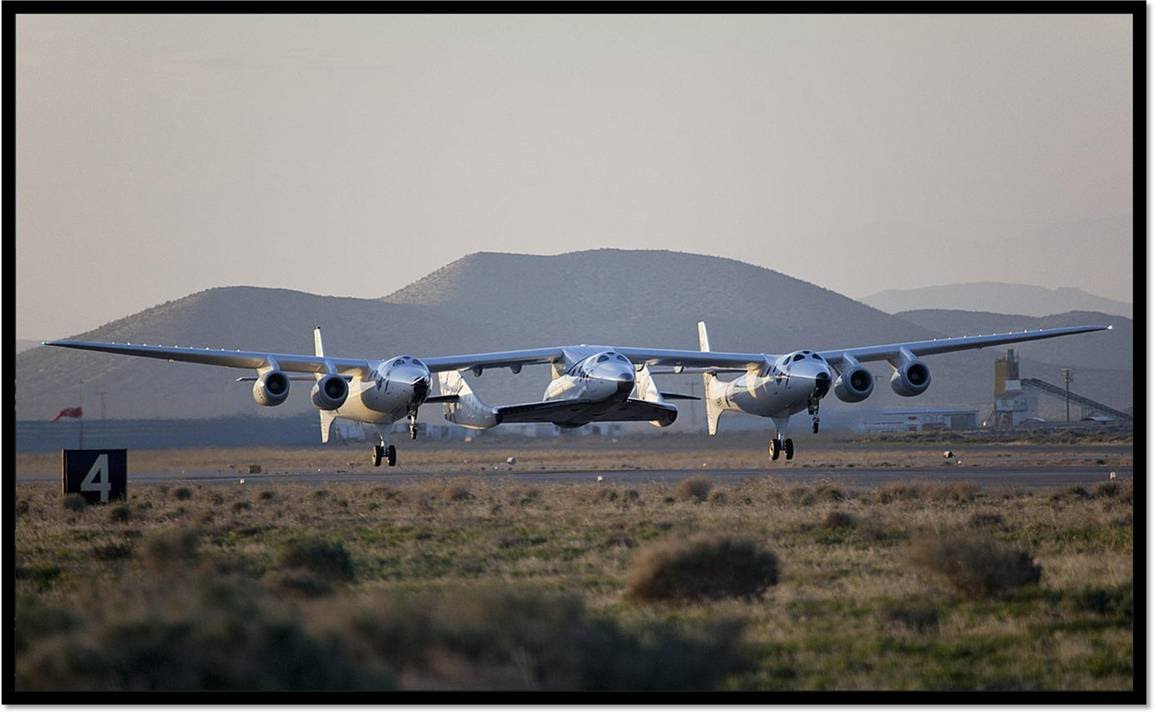
First Flight of Virgin Galactic's SpaceShip Two


Virgin Galactic, the private aerospace company founded by billionaire Richard Branson, successfully tested the passenger space-plane SpaceShipTwo today. SpaceShipTwo (SS2), is also called the Virgin Space Ship Enterprise, or VSS Enterprise, an obvious tribute to another space vehicle of some note. SS2 was carried to 45,000 feet (13.7km) by its mothership, named WhiteKnightTwo (WK2), or 'Eve', after Branson's mother. In this initial 'captive carry' test of the space plane, it remained attached to the mothership for the duration of the flight.

The SS2/WK2 combo took off from a runway at the Mojave Air and Space Port in California, and flew for approximately three hours over the deserts of the Antelope Valley. SS2 is a prototype passenger vehicle that is designed to take astronauts to suborbital flight. If the remaining tests go as planned, it will eventually take a crew of two pilots and up to six passengers to the edge of space, at just over 100km (62 miles).This may happen as early as the end of 2011.

Friday, October 23, 2009

Spitzer discovers largest ring around Saturn


This is from an e-mail I received from an engineering and musician acquaintance. I am not sure of the original source of the material.

The Spitzer Space Telescope has discovered an enormous ring around Saturn -- by far the largest of the giant planet's many rings. The Ball Aerospace-built Multiband Imagaing Photometer captured the infrared image that led to the discovery.

The new belt lies at the far reaches of the Saturnian system, with an orbit tilted 27 degrees from the main ring plane. The bulk of its material starts about six million kilometers (3.7 million miles) away from the planet and extends outward roughly another 12 million kilometers (7.4 million miles). One of Saturn's farthest moons, Phoebe, circles within the newfound ring, and is likely the source of its material.

Saturn's newest halo is thick, too -- its vertical height is about 20 times the diameter of the planet. It would take about one billion Earths stacked together to fill the ring.

"This is one supersized ring," said Anne Verbiscer, an astronomer at the University of Virginia, Charlottesville. "If you could see the ring, it would span the width of two full moons' worth of sky, one on either side of Saturn." Verbiscer; Douglas Hamilton of the University of Maryland, College Park; and Michael Skrutskie, of the University of Virginia, Charlottesville, are authors of a paper about the discovery to be published online tomorrow by the journal Nature.


That is a huge ring of material. The fact that it is not in the equatorial plane of Saturn makes it very unusual, but also makes the source of the material very easy to deduce.

Update: I wanted to make sure about this before I posted it. Saturn's moon Phoebe is very unusual. It has a highly elliptical orbit, which indicates it may be a captured object and did not condense from the disk of planetary accretion material from which Saturn eventually coalesced. It also has a very unusual makeup. From wiki:

However, images from the Cassini-Huygens space probe indicate that Phoebe's craters show a considerable variation in brightness, which indicate the presence of large quantities of ice below a relatively thin blanket of dark surface deposits some 300 to 500 metres (980 to 1,600 ft) thick. In addition, quantities of carbon dioxide have been detected on the surface, a finding which has never been replicated on an asteroid. It is estimated that Phoebe is about 50% rock, as opposed to the 35% or so that typifies Saturn's inner moons. For these reasons, scientists are coming to believe that Phoebe is in fact a captured Centaur, one of a number of icy planetoids from the Kuiper belt that orbit the Sun between Jupiter and Neptune[13][14]. Phoebe is the first such object to be imaged as anything other than a dot.

Saturday, September 12, 2009

New photo from the updated Hubble Telescope.


Since we seem to be on a space kick, both real and fictional, here's a newly released photo from NASA taken by the Hubble Space Telescope. Astounding. This photo is a Portrait of Stephan's Quintet, also known as the Hickson Compact Group 92. Please check out this link to see more photos.

Friday, September 11, 2009

Some amazing photos from the last Space Shuttle mission to the International Space Station.


Notice the person in the space suit working on the ISS in the fourth picture. Look directly at the center of the picture. He is rather difficult to see if you aren't looking. That must be quite a rush.


UPDATE: When I said "last" in the title of this post, I didn't mean "the last mission." I meant, "the most recent." The last one should be coming soon enough. I will have a post in the near future about NASA and the future of the U.S. in space.

Sunday, July 19, 2009

I want to say a word about Kindle, Amazon’s electronic book viewer.


I know that Americans are usually obsessed with owning the newest and hippest thing available. It doesn’t matter that the older thing is still quite functional. It becomes obsolete because it is deemed to be obsolete by the industry and the consumers.

On some occasions, this is warranted. No one really wants 8 track or even cassette tapes anymore. I keep hearing that the death of musical CD’s is imminent, although I have a feeling those are going to hang on for quite a while. I am still quite annoyed that my perfectly good printer/scanner/copier is obsolete and not supported and I can’t use the scanner feature anymore because HP decided they weren’t going to make a new application software for Windows XP and beyond. So, just because we upgraded our computer, we are now without a scanner. I find that infuriating.

All right, that was a bit of an unnecessary diversion. I wanted to talk about why Kindle is even a product available for sale. The base models cost about $300. Even with that outlay, you still have to buy the e-books, unless you are into the free classics. The hardware will, no doubt, need to have upgrades every once in a while. It will probably also do all sorts of cool stuff like be able to surf the internet and such, which a person’s cell phone or blackberry already does if that person is inclined to have the coolest thing.

My point being, this is rather a pricey proposition. Plus, we now need the manufacturing and support capabilities necessary to build and maintain these things. More toxic waste will be generated by the manufacture and disposal of these things. So, what the heck is wrong with just buying the damn book? Yeah, O.K., new hardcover books are expensive and they are printed on paper, which requires dead trees. But still, is just the fact that you have a Kindle, that you are among those who have the newest and hippest thing available, really that much of a rush that we have to have an entirely new and expensive electronics gadget to replace something, in this case, printed books, really necessary?

I admit, I am a book person. I have a nice little library where my shelves are full of books (and DVD’s), many of which are rather old. I didn’t buy them new. I would love to know the history behind some of the books I have. I have a number that were printed in the late 1890’s. I find that fascinating all by itself, much less the subject of the book itself. I just think we are losing something with this move. I frankly, just don't see the point.

Sure, printed books will always be with us. Hopefully, in the future, they won’t be looked upon as anachronistic antiques.

Wednesday, January 14, 2009

Could the future transportation needs of the U.S. be met with trains?


I just finished reading a really informative feature story on the Washington Monthly blog. It covers a lot of ground, but it is mostly advocating a radical increase in spending on railroad infrastructure. Transporting freight by rail is much more efficient than by a fleet of trucks. It has the additional benefit of being also much safer, as it takes a significant amount of truck traffic off our already congested and sometimes unsafe highway system.

The significant downside of increasing the use of rail traffic for our transportation needs is that the current system is pretty maxed out right now, and railroad infrastructure is very costly.

However, when all aspects are considered, it would appear that the United States ought to at least consider a large-scale jump in our railroad capacity. Expecting the railroads themselves to fund this expansion is not terribly realistic, although many are already laying new tracks with their own funds.

The feature in the Washington Monthly discussed one very interesting point that I had not really considered before. That is, what would power this next generation rail system? Diesel locomotives, although they are getting better all the time, are still based on internal combustion engines that consume petroleum products and emit pollutants. Because all industries should be considering how to “go green” in the 21st century where energy is going to become more and more precious, the railroad industry should stop and think a bit about this. The proposal laid out is to use wind power, especially in the central plain states, to power electric locomotives. Windfarms could be built alongside the tracks, which would have a couple of positive benefits. First, the transmission lines would not need to be very long. Electrical grids lose quite a lot power just by energizing the system. These losses can be rather substantial if the grid is not well maintained. The other benefit is that the trains themselves could just bring all the materials for windfarms and dump them by the side of the tracks. Modern windmills are very high-tech and rather massive. By having the windfarms set up shop in very close vicinity to railroad tracks, transporting the windmill components becomes less challenging than by trucking in large components to out-of-the-way locations.

Electric locomotives are not widely used in the U.S., except for the Northeast corridor (Boston, New York, D.C.) and other metro areas. However, at one time, electrified rail lines, such as the one shown in the picture above, were commonplace. They are able to generate a significantly larger percentage of pulling power over diesel-powered locomotives, since diesels must carry large reciprocating engines, electrical power generators and diesel fuel. Electrically powered locomotives pull power directly from the grid above and send it directly to the electric motors that drive the wheels. They also have one other added benefit. Train locomotives use a braking technique to slow down called dynamic braking. The electric motors that usually drive the wheels are used instead as brakes, which generate electric power. In diesel locomotives, this generated electricity just goes into big radiators and is lost as heat. With an electrified rail line, however, this electrical power can be put back into the electrical lines above for use by another train.

Here in Washington state, electric locomotives made quite a bit of sense. Both the Great Northern Railroad and The Milwaukee Road made heavy use of electric locomotives in the early and mid-20th Century. Hydroelectric power was cheap and plentiful. There was also the presence of an imposing tunnel through the Cascade Mountains at Stevens Pass. The Great Northern Railroad suffered a potentially catastrophic accident when one of its trains powered by a coal burning steam locomotive got caught in the tunnel. The crew and all the passengers could have easily asphyxiated. Luckily, the train was able to back out of the tunnel. This event caused Great Northern management to reconsider this approach. The Great Northern ended up installing an electrified rail line from Skykomish, on the western slopes of the Cascades, to Wenatchee, near the Columbia River in eastern Washington. The dam built by the Great Northern across the Wenatchee River up from Leavenworth, Washington, that was used to house the electrical generators that powered this section of GN track still remains today.

Electrically driven railroad locomotives are not some vast leap in technology. It is technology that was in use from the 1930’s, and is still in use to today. The building of such a transportation infrastructure would be costly, but it would generate a not insignificant number of new jobs and well as address the country’s growing transportation needs. I would hope that there are some forward looking people in this country would might consider this proposal as something more than just a pipedream. Given the looming shortages in fossil fuels and the need to develop more “green” industries, the U.S. could do a lot worse than spend some resources in this area.

(The picture above is of the Milwaukee Road electrified rail line through the town of Renton, Washington. The picture is from 1971, and comes from the website, rrpicturearchives.net. This is from the collection of Martin Burwash. I hope that he won’t mind me using the picture, as I am providing a link. For train enthusiasts, this is a very cool web site and includes a great deal of historical railroad photos.)

Saturday, April 26, 2008

Entitlement


According to Webster’s, the definition of “entitlement” is:

NOUN:
1. The act or process of entitling.
2. The state of being entitled.
3. A government program that guarantees and provides benefits to a particular group: "fights . . . to preserve victories won a generation ago, like the Medicaid entitlement for the poor" (Jason DeParle).


Many people in the Republican party are all up in arms about “entitlements”. In their world, this means things like Medicare, Medicaid, Social Security, veteran’s benefits, subsidies for farmers, etc. Oh, wait a second. Farm subsidies in heavily rural areas which tend to be Republican strongholds like Iowa and Oklahoma aren't entitlements. Those are "good things". I forgot myself for a bit. Entitlements are things that the government has promised people, and people now depend on these payments. Things could get really tough for some of these folks if these pacts between the government and the citizens of this country, i.e., entitlements, were to be suddenly voided. In the world of conservatives, entitlements are tantamount to socialism. And, as “everyone knows”, socialism is evil and doesn’t work, and besides people in Canada waiting for hip replacement surgery have to wait over a year!

However, as interesting a subject as that is, that isn’t really what I want to talk about. I only introduced that meaning as a way of explaining what I am not talking about. How’s that for being vague?

Bob Herbert wrote an eye-popping column in the New York Times. Here is a little snippet.

An American kid drops out of high school every 26 seconds. That’s more than a million every year, a sign of big trouble for these largely clueless youngsters in an era in which a college education is crucial to maintaining a middle-class quality of life — and for the country as a whole in a world that is becoming more hotly competitive every day.

Ignorance in the United States is not just bliss, it’s widespread. A recent survey of teenagers by the education advocacy group Common Core found that a quarter could not identify Adolf Hitler, a third did not know that the Bill of Rights guaranteed freedom of speech and religion, and fewer than half knew that the Civil War took place between 1850 and 1900.

“We have one of the highest dropout rates in the industrialized world,” said Allan Golston, the president of U.S. programs for the Bill and Melinda Gates Foundation. In a discussion over lunch recently he described the situation as “actually pretty scary, alarming.”

Roughly a third of all American high school students drop out. Another third graduate but are not prepared for the next stage of life — either productive work or some form of post-secondary education.

When two-thirds of all teenagers old enough to graduate from high school are incapable of mastering college-level work, the nation is doing something awfully wrong.


This got me thinking a bit. Here is what I was thinking about when the word “entitlement” popped into my mind. Entitlement, to me, means something that people just expect to have or receive, without really any basis for that expectation. It, whatever "it" is, is a God given right and no one should even question as to why I deserve it.

For example, the citizens of the U.S. have a mindset that says that this country is the greatest country that has ever been and can do no wrong. That way of thinking is obviously behind some of anger that pops out of the extreme right any time the left accuses George Bush of… just about anything. “How dare you, you Blame-America-Firster, you!” As if George Bush and the United States of America are the same thing…. Anyway, back to the point I am trying to make. Americans, back in the 40's, 50's and even early 60's, had good reasons for this attitude. After all, we were on the winning side in both World Wars. We were at the core of the free world during the Cold War. (Yes, Korea and Vietnam happened, those just don’t fit too well into the established narrative.) Our industrial might was second to none, we were the source of innovation and technology. We put men on the moon. We beat the Russians in hockey at Lake Placid. The Berlin Wall came down. All other nations either followed our lead or else were very wary of us. We were a supertanker in a lake full of sailboats.

However, things have changed without many Americans not having noticed that the world is a much different place than it was in the 1950’s. We still have this feeling of entitlement (See? I knew I would get around to making the connection sooner or later) that the position of America is still predominate in the world. Everyone else should concede to the superiorousness of the United States and kowtow whenever we feel we should be kowtowed to. We, as citizens of the United States of America, are entitled to all the adulation that the world can toss at us! If they don’t, then there is something seriously wrong with that country!

In the beginning of the 21st Century, the United States is still a large player in the world. However, this feeling of entitlement by the good citizens of this country make it really difficult to see, at times, that the U.S. has no real reason for this feeling of superiority. We are constantly being outclassed by other countries in the world on many fronts. Two of the few reasons remaining that other countries pay any attention to us at all is 1) we still have a bigger military than the rest of the world, combined, and 2) we have one of the largest consumer markets in the world. We are really good at buying stuff from other countries and throwing our weight around, militarily. Other than that, we don’t seem to be doing great shakes about much of anything. Our economy is teetering on the edge of meltdown, companies are abandoning the U.S. in the hopes they can make more money elsewhere, we have very little in the way of manufacturing left in this country, one third of our students don’t even graduate high school, and the few good jobs that do remain require a college degree. Things are not looking too swell for the future. In fact, “bleak” doesn’t even begin to cover it, in my mind. “Damn frightening” is more like it.

I agree with the central premise of Herbert's column. On the whole, the population of this country is really ignorant, and they are damn proud of it, too! Don’t tell US about problems like global climate change or oil at $150 a barrel! We know better! Facts be damned! We have our opinion, and that is MUCH better than facts. More people now believe in UFO's than they do in evolution.

So, even though everything is going to the crapper here in the good ol’ U.S. of A., most of the people in this country STILL expect us to be the Top Dog, the King of the Hill. God Bless America! (Which sort of implies, in my mind, that God couldn’t give a damn about all those other countries that aren’t America.) No one should ever tell us what to do, and we can demand, at any time for any reason, that others do our bidding at the drop of a hat or else we will start calling them insulting names like “Old Europe” or “cheese eating surrender monkeys”. China and Japan are expected to buy up our debt so we can continue on throwing money at the rich people of this country and in the black hole that is Iraq.

I can’t help but feel that many people in this country are in for a very, very rude awakening in about 15 or 20 years. I am just hoping, for very selfish reasons, it isn’t sooner than that. But I do feel very badly for the children and young people in this country, because they are going to inherent a world in which the “entitlements” they have been taught are rightfully ours are a thing of the past.

Money roll picture from here.