Showing posts with label astronomy. Show all posts

Friday, October 28, 2011

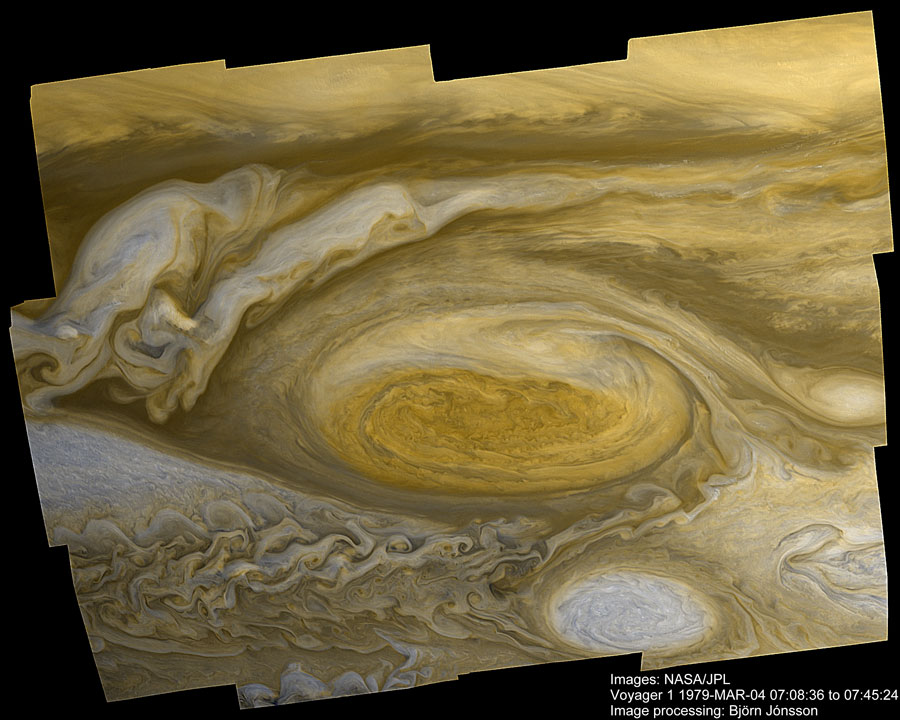
Science moment of the day: Jupiter's Great Red Spot


Wow. That's about all the narrative necessary for this one. Just, wow....

Snapped from the New Horizons spacecraft on its way to Saturn.

Photo from NASA. Click on the photo for a (slightly) enlarged version.

Tuesday, May 25, 2010

Saturn


Above photo and text from here.

In the shadow of Saturn, unexpected wonders appear. The robotic Cassini spacecraft now orbiting Saturn recently drifted in giant planet's shadow for about 12 hours and looked back toward the eclipsed Sun. Cassini saw a view unlike any other. First, the night side of Saturn is seen to be partly lit by light reflected from its own majestic ring system. Next, the rings themselves appear dark when silhouetted against Saturn, but quite bright when viewed away from Saturn and slightly scattering sunlight, in the above exaggerated color image. Saturn's rings light up so much that new rings were discovered, although they are hard to see in the above image. Visible in spectacular detail, however, is Saturn's E ring, the ring created by the newly discovered ice-fountains of the moon Enceladus, and the outermost ring visible above. Far in the distance, visible on the image left just above the bright main rings, is the almost ignorable pale blue dot of Earth.


That may be the most beautiful photograph ever taken. Click on the photo to get a larger version, and then look for the dot in the upper left hand quadrant. That's Earth. Everything that you and I have ever read about or heard about took place there. Except for a few things that happened on the moon, of course.


The surface of Saturn's moon Dione, up close.


Tiny moon Janus, seen before Saturn's rings, with massive moon Titan beyond.


Saturn’s polar region.


Saturn's moon Enceladus, seen just in front of Saturn.

The four bottom photos from here, courtesy of NASA/JPL-Caltech.

Friday, May 07, 2010

Another great shot from Hubble.


Because I am really bummed out by everything else that's going on....

(You can click on the picture to get a slightly larger version.)

Wednesday, March 03, 2010

Mars moon Phobos


Photo from Bad Astronomy.


That's a very cool photo from the European Mars Express. There should be more very interesting photos in the near future, as the closest approach to Phobos will be on March 3 (which is actually today, the day I am posting this).

I am very intrigued by the parallel grooves on Phobos. The text from Bad Astronomy says that the current thinking is that they are cracks due to a previous collision. That's not really what they look like to me. And I am not sure they would all end up being parallel like that. It looks like to me that many items were orbiting so closely to the moon that they actually begin to touch the surface and cut grooves into the surface before those items (perhaps debris from a previous collision or encounter) eventually came to rest on the surface. Whatever those are, they certainly are interesting. The entire presentation looks like a misshapen potato that has been put in one of those do-dads that cuts curly fries out of the potato by rotating the potato along the major axis and putting a cutting tool on the surface while its rotating, but the process came to a halt right after the cutting surface just grazed the surface.

Boy, was that a deeply scientific explanation or what?

Friday, January 29, 2010

Tethys Behind Titan


What's that behind Titan? It's another of Saturn's moons: Tethys. The robotic Cassini spacecraft orbiting Saturn captured the heavily cratered Tethys slipping behind Saturn's atmosphere-shrouded Titan late last year. The largest crater on Tethys, Odysseus, is easily visible on the distant moon. Titan shows not only its thick and opaque orange lower atmosphere, but also an unusual upper layer of blue-tinted haze. Tethys, at about 2 million kilometers distant, was twice as far from Cassini as was Titan when the above image was taken. In 2004, Cassini released the Hyugens probe which landed on Titan and provided humanity's first views of the surface of the Solar System's only known lake-bearing moon.

Photo and text from NASA's Astronomical Photo of the Day. See list at the right for a link. Credit: Cassini Imaging Team, ISS, JPL, ESA, NASA.