Showing posts with label universe. Show all posts

Friday, October 28, 2011

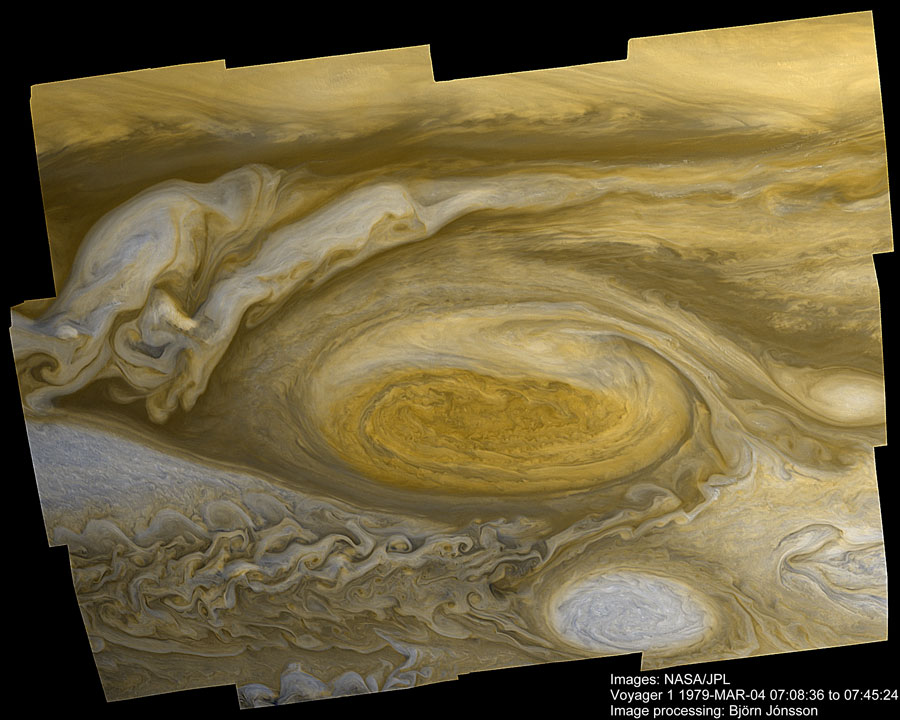
Science moment of the day: Jupiter's Great Red Spot


Wow. That's about all the narrative necessary for this one. Just, wow....

Snapped from the New Horizons spacecraft on its way to Saturn.

Photo from NASA. Click on the photo for a (slightly) enlarged version.

Tuesday, May 25, 2010

Saturn


Above photo and text from here.

In the shadow of Saturn, unexpected wonders appear. The robotic Cassini spacecraft now orbiting Saturn recently drifted in giant planet's shadow for about 12 hours and looked back toward the eclipsed Sun. Cassini saw a view unlike any other. First, the night side of Saturn is seen to be partly lit by light reflected from its own majestic ring system. Next, the rings themselves appear dark when silhouetted against Saturn, but quite bright when viewed away from Saturn and slightly scattering sunlight, in the above exaggerated color image. Saturn's rings light up so much that new rings were discovered, although they are hard to see in the above image. Visible in spectacular detail, however, is Saturn's E ring, the ring created by the newly discovered ice-fountains of the moon Enceladus, and the outermost ring visible above. Far in the distance, visible on the image left just above the bright main rings, is the almost ignorable pale blue dot of Earth.


That may be the most beautiful photograph ever taken. Click on the photo to get a larger version, and then look for the dot in the upper left hand quadrant. That's Earth. Everything that you and I have ever read about or heard about took place there. Except for a few things that happened on the moon, of course.


The surface of Saturn's moon Dione, up close.


Tiny moon Janus, seen before Saturn's rings, with massive moon Titan beyond.


Saturn’s polar region.


Saturn's moon Enceladus, seen just in front of Saturn.

The four bottom photos from here, courtesy of NASA/JPL-Caltech.

Wednesday, March 17, 2010

Detailed View of a Solar Eclipse Corona


Photo Credit & Copyright: Miloslav Druckmüller (Brno University of Technology), Martin Dietzel, Peter Aniol, Vojtech Rušin
Only in the fleeting darkness of a total solar eclipse is the light of the solar corona easily visible. Normally overwhelmed by the bright solar disk, the expansive corona, the sun's outer atmosphere, is an alluring sight. But the subtle details and extreme ranges in the corona's brightness, although discernible to the eye, are notoriously difficult to photograph. Pictured above, however, using multiple images and digital processing, is a detailed image of the Sun's corona taken during the 2008 August total solar eclipse from Mongolia. Clearly visible are intricate layers and glowing caustics of an ever changing mixture of hot gas and magnetic fields. Bright looping prominences appear pink just above the Sun's limb. The next total solar eclipse will be in July but will only be visible in a thin swath of Earth crossing the southern Pacific Ocean and South America.

Friday, October 23, 2009

Spitzer discovers largest ring around Saturn


This is from an e-mail I received from an engineering and musician acquaintance. I am not sure of the original source of the material.

The Spitzer Space Telescope has discovered an enormous ring around Saturn -- by far the largest of the giant planet's many rings. The Ball Aerospace-built Multiband Imagaing Photometer captured the infrared image that led to the discovery.

The new belt lies at the far reaches of the Saturnian system, with an orbit tilted 27 degrees from the main ring plane. The bulk of its material starts about six million kilometers (3.7 million miles) away from the planet and extends outward roughly another 12 million kilometers (7.4 million miles). One of Saturn's farthest moons, Phoebe, circles within the newfound ring, and is likely the source of its material.

Saturn's newest halo is thick, too -- its vertical height is about 20 times the diameter of the planet. It would take about one billion Earths stacked together to fill the ring.

"This is one supersized ring," said Anne Verbiscer, an astronomer at the University of Virginia, Charlottesville. "If you could see the ring, it would span the width of two full moons' worth of sky, one on either side of Saturn." Verbiscer; Douglas Hamilton of the University of Maryland, College Park; and Michael Skrutskie, of the University of Virginia, Charlottesville, are authors of a paper about the discovery to be published online tomorrow by the journal Nature.


That is a huge ring of material. The fact that it is not in the equatorial plane of Saturn makes it very unusual, but also makes the source of the material very easy to deduce.

Update: I wanted to make sure about this before I posted it. Saturn's moon Phoebe is very unusual. It has a highly elliptical orbit, which indicates it may be a captured object and did not condense from the disk of planetary accretion material from which Saturn eventually coalesced. It also has a very unusual makeup. From wiki:

However, images from the Cassini-Huygens space probe indicate that Phoebe's craters show a considerable variation in brightness, which indicate the presence of large quantities of ice below a relatively thin blanket of dark surface deposits some 300 to 500 metres (980 to 1,600 ft) thick. In addition, quantities of carbon dioxide have been detected on the surface, a finding which has never been replicated on an asteroid. It is estimated that Phoebe is about 50% rock, as opposed to the 35% or so that typifies Saturn's inner moons. For these reasons, scientists are coming to believe that Phoebe is in fact a captured Centaur, one of a number of icy planetoids from the Kuiper belt that orbit the Sun between Jupiter and Neptune[13][14]. Phoebe is the first such object to be imaged as anything other than a dot.

Wednesday, September 23, 2009

A very angry, anonymous video blogger (with a very cute accent) takes apart Kirk Cameron.

Please check out this link. This is really funny and really good at the same time.

I didn't realize that Kirk Cameron (who was hardly on my radar anyway) is now somehow the spokesman for creationism. Watch this lady take him apart, piece by piece.

(One of these days, I am going to take the time to figure out how to download You Tube videos and embed them directly into my posts here. But, until then, just click the link. It's worthwhile.)

Saturday, September 12, 2009

New photo from the updated Hubble Telescope.


Since we seem to be on a space kick, both real and fictional, here's a newly released photo from NASA taken by the Hubble Space Telescope. Astounding. This photo is a Portrait of Stephan's Quintet, also known as the Hickson Compact Group 92. Please check out this link to see more photos.

Friday, July 10, 2009

Amazing astronomical photo


This is today's Astronomical Photo of the Day from NASA. Isn't that absolutely incredible?

And here is the explanation given:

The Pillars of Eagle Castle

Credit & Copyright: Emanuele Colognato & Jim Wood (Backyard Skies)

Explanation: What lights up this castle of star formation? The familiar Eagle Nebula glows bright in many colors at once. The above image is a composite of three of these glowing gas colors. Pillars of dark dust nicely outline some of the denser towers of star formation. Energetic light from young massive stars causes the gas to glow and effectively boils away part of the dust and gas from its birth pillar. Many of these stars will explode after several million years, returning most of their elements back to the nebula which formed them. This process is forming an open cluster of stars known as M16.


O.K., yes. This photo is under copyright. I am thinking it will be O.K. if I give them attribution and a link. Please go visit their home page.

Wednesday, March 04, 2009

Asteriod narrowly misses Rush Limbaugh. Catestrophe averted.


"I dunno, Earl. I was just about ready to sit down and listen to Rush on the radio when this here rock came right through the ceiling and dun squashed my favorite chair.!"


Apparently, the Earth just had a near miss (or actually, a “near hit” is more appropriate) with a cosmic visitor. From Yahoo News:

PASADENA, Calif. – An asteroid about the size of one that blasted Siberia a century ago just buzzed by Earth.

NASA's Jet Propulsion Laboratory reported that the asteroid zoomed past Monday morning.

The asteroid named 2009 DD45 was about 48,800 miles from Earth. That is just twice the height of some telecommunications satellites and about a fifth of the distance to the Moon.

The space ball measured between 69 feet and 154 feet in diameter. The Planetary Society said that made it the same size as an asteroid that exploded over Siberia in 1908 and leveled more than 800 square miles of forest.

Most people probably didn't notice the cosmic close call. The asteroid was only spotted two days ago and at its closest point passed over the Pacific Ocean near Tahiti.


You know, as comsic distances go, that’s pretty close. I suppose we can all do a collective “Whew!” and wiped our brows. It’s really only a matter of time, I suppose, before we take a direct hit. It may be next year, and it may not be for several hundred million. I still like our odds, even though an event like that gives one pause.

One upside of taking a hit from an asteriod, though, is that it might do wonders to clear up that nasty “global warming” thing we have going on.

Sunday, December 07, 2008

Is the Earth’s magnetic field getting ready to flip polarities?


There is some very interesting and somewhat alarming data being collected on the Earth’s magnetic field. Here are a couple of items that fit into that category. The Earth’s magnetic field is about 10% weaker now than it was 150 years ago. That’s pretty staggering. 150 years in geologic time represents a blink of the eye, and 10% of anything is a pretty significant percentage, especially something as powerful as the planetary magnetic field. That change represents a huge amount of energy. The other interesting data point is that there is a very weak spot in the magnetic field over the southern Atlantic off the coast of Brazil where the local magnetic field about 30% of the normal strength of rest of the field.

I have discussed the importance of the Earth’s magnetic field before, in the context of how crucial it was for the formation of life on Earth. It protects the Earth’s atmosphere, oceans and all the life on the surface of the planet from the solar wind. The term “solar wind” is a pretty benign sounding, given how much havoc it can wreak on anything left unprotected. The solar wind consists of massive amounts of highly energized particles streaming off the sun’s corona. Normally, the Earth’s magnetic field funnels all these particles into the polar regions, which results in spectacular displays called the Northern Lights. A planetary atmospheric system left unprotected from the solar wind for millions of years would result in the atmosphere blasted off the surface of the planet and into space. The oceans would eventually evaporate. The result would be a dead, barren planet like Mars. In fact, that is exactly the scenario being discussed among planetary scientists to explain why Mars obviously once had large amounts of water flowing on the surface. Evidence is showing that Mars may once have had a magnetic field protecting it, but it does not now.

If Earth’s magnetic field continues to decay, it could suffer the same fate as Mars. Put on a liner scale, given the present rate of decay, the entire magnetic field could be gone within 1500 years. Global warming and widespread climate change would be a minor annoyance compared to this apocalyptic scenario. Global climate change might be catastrophic to mankind, but many of the current species on Earth would adapt and survive. The Earth, as a living entity, would survive in some form. However, the loss of the protective magnetic shield and the subsequent loss of the atmosphere and oceans would result in a dead planet.

Thankfully, many scientists are predicting that this doomsday scenario is unlikely. Fluctuations of the magnetic field appear to be the norm. Another scenario is that the Earth’s magnetic poles are getting ready to flip. That is, what used to be the “+” magnetic pole on the northern axis of the globe, after some rather wild fluctuations, will end up at the south pole. This has happened many times in the past, and will undoubtedly happen again in the future. The instability of the field before this occurs could lead to loss of radio and satellite communications, the possibility of intermittent failures of power grids, etc. for possibly years. However, compared with the possibility of the slow death of the entire planet, these effects should be considered relatively minor.

Photo from here.

Thursday, October 23, 2008

Cassini comes within fifteen miles of Saturn’s moon, Enceladus.


The picture and following text are from the Oct. 20th issue of Aviation Week and Space Technology. Sorry, no link, as it is a subscriber-only web site.

NASA/ESA Cassini spacecraft imaged Saturn’s moon Enceladus from only 26,000 mi. as Cassini climbed away after passing within only 15 mi. of Enceladus’s surface Oct. 9. The daring dive was made to sample the geysers of water and other contents that explode from fissures in the surface such as the giant canyon that cuts across half of the 330-mi.-dia. Enceladus. The resolution of this raw unprocessed image is 1,650 ft. per pixel. A second dive is planned Oct. 31. Enceladus is one of several areas around Jupiter, Saturn and Mars where the search for water is intensifying in relation to the search for alien life (see p. 56). NASA/JPL/SSI image.

The Enceladus flyby down to 15 mi. is enabling the Cassini fields and particles teams to start indentifying specific constituents, like more complex carbons, that had not been seen in the plumes before an August approach down to 31 mi., says Cassini project scientist Bob Pappalardo. During the earlier flyby, the dust analyzer instrument could tell that the plumes form a fist-shaped structure at higher altitude above Enceladus. But this time, flying much lower, the instruments could detect “individual finger-shaped plumes” making up the jets as Cassini zoomed through at 40,000 mph., Pappalardo told Aviation Week & Space Technology.

-snip-

Cassini scientists are elated, Pappalardo says, because this new information could help build evidence that Enceladus may harbor a subsurface ocean, warm enough to host a stew of living organisms a billion miles from Earth.


These are just absolutely astounding photos. I just can’t find any appropriate words about how amazing I find our ability to explore our solar system. Just think, for a moment, about how many brilliant minds have contemplated might what actually be out there and what it might look like. And now, we are finding out!

Monday, January 28, 2008

Talk of “climate change” no more. No, it’s a new Epoch for the Earth.


From Yahoo News:

Say goodbye to the 10,000-year-old Holocene Epoch and hello to the Anthropocene.

Among the major changes heralding this two-century-old man-made epoch:

· Vastly altered sediment erosion and deposition patterns.

· Major disturbances to the carbon cycle and global temperature.

· Wholesale changes in biology, from altered flowering times to new migration patterns.

· Acidification of the ocean, which threatens tiny marine life that forms the bottom of the food chain.

-snip-

Earth's 4.5-billion-year history is divided into major eras, then periods and finally epochs. The Holocene Epoch began after the last Ice Age.

As early as the late 1800s scientists were writing about man's wholesale impact on the planet and the possibility of an "anthropozoic era" having begun, according to Crutzen, who is credited with coining the term Anthropocene (anthropo = human; cene = new) back in 2000. That year, Crutzen and a colleague wrote in the scientific newsletter International Geosphere-Biosphere Programme about some of the dramatic changes:

"Urbanization has ... increased tenfold in the past century. In a few generations mankind is exhausting the fossil fuels that were generated over several hundred million years."

Up to half of Earth's land has been transformed by human activity, wrote Crutzen and Eugene F. Stoermer of the University of Michigan. They also noted the dramatic increase in greenhouse gases and other chemicals and pollutants humans have introduced into global ecosystems.


It appears that even some hardcore Conservatives are coming around to the view that things are changing rapidly, in some very dramatic ways. Yet, there is always going to be that 20 to 30% who believe that this is nothing more than a “liberal plot”. Usually, plots have some sort of goal, like the Bush administration hiding behind “executive privilege”, such that they don’t have to explain any of their underhanded actions to anyone. What the point of this supposed “liberal plot” might be, I have no idea.

Humans, as a species, can be incredibly stupid and short sighted. The Earth, in some form or fashion, will survive. It has through many, many changes in the past, and will no doubt do so in the future. However, whether or not the climate will provide a nice habitat for humans and our society remains to be seen.

Saturday, January 19, 2008

Messenger probes passes Mercury!


More knowledge about the solar system is being added in big chunks as the first spacecraft in some 30 years takes pictures of the planet Mercury.

I find this type of subject so fascinating. Humans, for as long as we have known about the existence of other planets, could only speculate about what they actually looked like in detail. Now we are finding out. I find exploration of space, by orbiting spacecraft, planetary rovers or telescopic observation (visible, x-ray, infrared, etc.) one of the more appealing things about our species. We now have the technology, as well as the will, to find out what our universe actually is.

There is speculation, no proof as of yet, that Mercury might have been a captured primordial body, similar to the one that collided with Earth during its formation and resulted in our Moon, and it did not actually form from accretion as did the other planets.

This is from NASA’s Astronomical Picture of the Day (APOD), a very cool web site indeed.

Two days ago, the MESSENGER spacecraft became only the second spacecraft in human history to swoop past Mercury. The last spacecraft to visit the Sun's closest planet was Mariner 10 over 35 years ago. Mariner 10 was not able to photograph Mercury's entire surface, and the images it did send back raised many questions. Therefore, much about planet Mercury remains unknown. This week's flyby of MESSENGER was only the first of three flybys. Over the next few years MESSENGER will swing past twice more and finally enter Mercury's orbit in 2011. MESSENGER is currently moving too fast to enter orbit around Mercury now. The above image was taken two days ago during MESSENGER's flyby and shows part of Mercury's surface that has never been imaged in detail before. Many more MESSENGER will hopefully help scientists better understand how Mercury's surface was formed, and why it is so dense.

The following text and picture at the top is from the Johns Hopkins Applied Physics Laboratory web site.


Just 21 minutes after MESSENGER’s closest approach to Mercury, the Narrow Angle Camera (NAC) took this picture showing a variety of intriguing surface features, including craters as small as about 300 meters (about 300 yards) across. This is one of a set of 68 NAC images showing landscapes near Mercury’s equator on the side of the planet never before imaged by spacecraft. From such highly detailed close-ups, planetary geologists can study the processes that have shaped Mercury’s surface over the past 4 billion years. One of the highest and longest scarps (cliffs) yet seen on Mercury curves from the top center down across the left side of this image. (The Sun is shining low from the right, so the scarp casts a wide shadow.) Great forces in Mercury’s crust have thrust the terrain occupying the right two-thirds of the picture up and over the terrain to the left. An impact crater has subsequently destroyed a small part of the scarp near the bottom of the image.

Sunday, January 13, 2008

The Day The Earth Stood Still: Klaatu as a Christ figure?


This idea was suggested to me a number of years ago on another web site I used to frequent quite often, of which all the contributors to this site, along with a couple of reliable readers, are alumni. Anyway, although it’s not quite in the same league as The DaVinci Code, it’s rather interesting for film buffs. These allegories were known the Robert Wise, the director, at the time.

Klaatu comes to Earth with a message of peace, but also a message of terrible retribution if this message of peace isn’t adopted. He is killed by the Powers That Be, who are afraid of his motives and what he might bring about. He is then brought back to life. When questioned about this by Patricia Neils character, Klaatu responds that the power of life and death is reserved only “the Almighty Spirit”. (This message was not intended in the original idea of the film, as it was imposed by a Production Code. They evidently thought that the idea of an all powerful, all knowing race was rather at odds with the idea of God being the only all powerful entity in the universe.) Klaatu, like Christ who cured the lepers and changed water into wine, exhibited extraordinary powers in causing all electricity around the world to stop. Even the name of “Carpenter” that Klaatu assumes while masquerading as a local inhabitant is reminiscent of the message of Christ.

It is difficult to determine just what to make of this allegory. Personally, I have never been too keen on allegory and symbolism. I tend to take things at face value. The Christ connection never occurred to me on my own until someone else pointed it out, just as the message in The Lion, The Witch, and the Wardrobe. Aslan as Christ never occurred to me. I work as an engineer and have training as a scientist. Clarity of information is paramount. Why anyone chooses to give a message by a method that is prone to personal interpretation, I have no idea. When I say this to anyone else, the answer I get back is, “That is the idea. What does it mean to you?” My answer back is, “I don’t know and I really don't care what I think. It’s YOUR story/movie/song. YOU tell ME what you intended. You obviously thought enough about your idea to put a lot of time and effort into it. I want to know what you intended. Why are you asking me to interpret something that you wrote?” To me, that’s just stupid. But then, I have found out that I don’t think like most people I know.

Therefore, it is difficult to reach any conclusions about what this Christ-like connection actually means in a sci-fi film from the 1050’s, when the concern those days was “The Red Menace”, “duck and cover” and building bomb shelters in your back yard. It is probably nothing more than an interesting idea that someone thought would make a compelling story, and as the film progressed, the more muddled it all became by other people in a position of power putting their fingerprints all over it.

My main concern about the message in this film is not the Christ connection. It is about the basic message that Klaatu delivered to Earth. “Become peaceful, or we will destroy you.” Talk about your basic contradictory message. “Do as I say, not as I do.” It just doesn’t really fit in with the concept of promoting peace and brotherly love. It is more of an ultimatum, not unlike that of the approach advocated by George Bush and Dick Cheney. “If we think you are threatening us, or even have the potential of threatening us sometime in the future, we reserve the right to annihilate you and to do so without a second thought.”

That is the message that I really have a problem with, in today’s politics or a sci-fi film.

More about this idea in contained in the IMDB entry for the movie, under “trivia”.

Monday, December 31, 2007

The top seven things I would like to ask Fundamentalist Christians.


Everyone seems to make lists at the end of the year. I am not sure why this is. Maybe it just puts some sort of order onto chaos. Maybe it’s just a tradition. Anyway, here is my entry on the plethora of lists at this time of the year. Here is my list of questions about which I would like to have answers from Fundamentalist Christians who believe that every single word of the Bible is true, and only true to their particular interpretation, including that the Earth is only around 6000 years old.

1. Fundamentalist Christians put mankind at the center of the universe, it seems. Everything revolves around us, just as humans would have believed 2000 years ago when we had no idea of what the universe we live in actually looks like. Yet, if you take a look at what we know of the universe now, even the galaxy we live is in just a speck in the vastness, and it takes light, traveling at 186,000 miles per second, over 100,000 years to get from one side of that one speck to the other. There are a hundred billion stars in our galaxy. There are billions of observable galaxies in the universe. Why would God bother with making such an immense and scarcely comprehensible universe, and at the same time, be concerned with every single individual and whether or not we believe in Him? This just seems so incredibly petty and small of a God that could create such a universe.

2. If, as you maintain, every single word of the Bible is “God’s Truth”, how do you explain the numerous contradictions and other inexplicable actions taken both by God and by his faithful? There are very obvious examples. Did Noah take two beasts of each kind? Or, was it “clean beasts thou shalt take to thee seven and seven, the male and his female”(Genesis 7.2)? It can’t be both, can it? Or, the famous question of, who was Cain’s wife and where did she come from, if Cain and Able were the only people in the world after Adam and Eve? Cain built an entire city and populated it only with his offspring? An entire city? Sounds pretty doubtful. I find the story of Joshua destroying the city of Jericho very cruel and bloodthirsty. Because Jehovah (God by another name) “gave” the city to Joshua (Joshua 6.1), it was acceptable then to destroy the city and either kill or expel all the city’s inhabitants, who had done nothing wrong in the least? That is a terrible, terrible thing to do to innocent people. Likewise, God commanding Abraham to kill his son, just to see if he would do it, seems like a terrible thing for God to do (Genesis 22.10). I would call that the ultimate “no win” situation. The Bible contains many requirements for burnt offerings, killing of those who are unlike you, etc. I want to hear how the Fundamentalist Christians explain all these very troubling and contradictory passages in God’s Truth.

3. Was the physical nature of the universe actually different than it is today? Having the sun rise in the west and set in the east is a physical impossibility and one, if it were actually to occur, would cause a catastrophe that would essentially destroy the Earth. Did this really occur, the Earth rotate in the opposite direction? Was the refraction of light impossible prior to the Great Flood? The Bible (Genesis 9.14) states that the rainbow is God’s promise that He will not destroy the Earth again by floods. Did the physics of light and refraction change? And, just as an aside, where did all the water go that was used to cover up all the surface of the Earth such that no dry land remained?

4. Much has been made about the animals that Noah took with him on his Ark. Fundamentalists have been forced to accept the existence of dinosaurs, since there is overwhelming evidence that they existed. The Bible never mentions them, but they must have existed. Therefore, fundamentalists, rather than try to work out how the Bible might be incorrect about time scales, just incorporated them into their own version of “The Truth”. That is, Noah took all the dinosaurs on the Ark with him. No further thought is required for this improbable hypothesis, it seems, but leaves unanswered the huge size of the beasts involved and the sheer numbers involved. It would be absolutely impossible to house even two of each kind of the dinosaurs, pterosaurs, and other animals that we know existed, given the Ark’s stated size (Genesis 6.15). Besides, maybe dinosaurs were “clean beasts”.

5. I want to know where Neanderthals fit into the picture. Neanderthals are just like dinosaurs. There is undeniable evidence that they existed in Europe and the Middle East, for over 100,000 years. Yet, Fundamentalist Christians ignore all this evidence, as it is just too difficult to work into their accepted biblical narrative. Neanderthals were definitely humans (not monkeys or apes) but not homo sapiens, either. They used tools. They buried their dead. Like the dinosaurs, did Noah carry Neanderthals on his Ark? Fundamentalist Christians like to make much of the hoax of the Piltdown Man (conveniently forgetting that scientists were the ones who uncovered the hoax, not Christians), but are totally silent on the subject of the Neanderthals.

6. How do all the heavily cratered objects in our solar system, such as the Moon, Mercury, and all the various moons of the gas giants, fit in with the theory that the Earth is only 6000 years old? Were all these other bodies already present, such that they reached their heavily cratered state (craters inside of older craters inside of older craters) prior to the Earth being created? It is not possible that these bodies were bombarded with millions of objects during their formation and the Earth was not. 6000 years is not enough time for even such as a geologically and meteorologically active place such as our Earth to fully erase the evidence of such bombardment. Where did all these bodies that impacted the major bodies in our solar system go, and why aren’t we hit every week or month by such an object?

7. There is ample geological evidence, which is visible to the naked eye and takes no formal training to understand, that discounts the notion of a very young Earth. How do Fundamentalist Christians explain things like the Hawaiian Islands, where the land building mechanism is easily observable? 6000 years is obviously not enough time for a volcanic “hot spot” in the crust of the earth create the chain of islands, each of which rises hundreds of thousands of feet from the ocean floor. Did God create all these islands and then just happen to create what just looks like geological evidence that would explain their creation? How are there fossils of forests and animals in Antarctica? Why are there places in Colorado which have dinosaur prints fossilized in solid rock, but are inclined at almost 90 degrees perpendicular to the surface of the Earth? How does the Bible explain plate tectonics and continental drift? Mountain ranges like the Himalayas just happened to be placed at the junction of these plates that are pushing against each other?

All attempts at explanations that the Bible seems to hold so dear seems to me to be an attempt my man who had very little knowledge of the actual world he inhabited. I can’t see any reason why I should take the story of Noah any more literally than I would a story from the Indians of the Pacific Northwest. They have a legend about the time when Whale fought with Bear, and much was destroyed. After putting many varying pieces of information together, it appears that this story was an attempt at explaining a very large earthquake and subsequent tsunami, which also inundated the coastline of Japan in the 1600’s or 1700’s, I am not sure which. The Native Americans of that time were attempting to explain something that they had no explanation for. Why is it not likely that the miracles and odd happenings in the Old Testament are along the same line? I cannot see that the inherent nature of our earth or our universe, or the fundamental laws of physics, changed since biblical times. So, why is what is in the Bible any more compelling than the legends of all the other religions?

I suppose religion is an individual’s way to try to get a handle on the universe, the uncertainty of our society, and, the ultimate question, what happens when we die. Obviously, our species has an inherent need for those kinds of explanations. We do not like uncertainty. But if you consult Occam’s Razor, the explanations that are coming from science, even though they are very, very strange (such as, how can an electron be a particle AND a wave at the same time), seem to make more sense to me that postulating a benevolent being that created the entire universe but seems to care about whether or not we believe in Him, on an individual basis.

Friday, December 21, 2007

A front row seat to a cosmic game of billiards?


Man, this could be a very interesting show. From the LA Times, via the Everett Herald.

An asteroid similar to the one that flattened forests in Siberia in 1908 could plow into Mars sometime in the next few weeks, scientists said.

Researchers attached to NASA's Near-Earth Objects Program, who like to call themselves the Solar System Defense Team, have been tracking the asteroid for days.

The scientists, based at the Jet Propulsion Laboratory in La Canada Flintridge, Calif., put the chances that it will hit the Red Planet at about 1 in 300. That's better odds than any known asteroid has ever had of hitting Earth, except for the Siberian strike, the scientists said.

The unnamed asteroid is about 160 feet across, which puts it in the range of the famous Siberian rock. The largest impact event in recent history, that explosion felled 80 million trees over an area of 830 square miles.

Concerns about another strike on Earth led to the creation of the Near-Earth Objects Program and the pursuit of research into possible ways of deflecting a killer asteroid.

Scientists say it's unclear what the effects of such an impact on Mars would be. The Martian atmosphere is so thin that an asteroid would likely plummet all the way to the surface instead of breaking up above ground, as happened in the Siberian event.

Once it hit, it would probably create a large crater and send plumes of dust high into the atmosphere, scientists said. Depending on where it hit, the plume could be visible through telescopes on Earth.

The Mars Reconnaissance Orbiter, which is currently mapping the planet, would have a front-row seat. NASA's two JPL-built rovers, Opportunity and Spirit, might also be able to take pictures from the ground of the impact's effects.

Monday, November 19, 2007

Pretty amazing photos from the Hubble


The Crab Nebula


NCG 602


V838 Monocerotis

Wednesday, October 24, 2007

Jupiter and Io


Pretty damn amazing photo.

Friday, August 17, 2007

Whose reality is it, anyway?


Earlier, I wrote a little bit about how reality is currently seen from the eyes of a modern day physicist. I have assimilated that perspective into my own views of “reality”, as that is my nature. I am one who gives great credence into the inquisitive nature of the human race. When we go about investigating the unknown with discipline and integrity, great things can be achieved. The most important thing that one can do is to keep an open mind. If you go about trying to get facts to confirm your own preconceived reality, then you are going about it incorrectly. By doing that, you are not trying to find out what “reality” actually is, you are just trying to bolster your reality as you see it, and are not interested in finding out anything new.

That’s what got me wondering about this question of “reality”. Reality seems to change constantly. So, does that mean that there is anything that can actually be called “reality” that doesn’t depend on human observation and cognition?

As I said, my reality is one that matches the latest views from the world of science, and has very little input from the religious or mystical realms. It’s not that I believe that science has the answer to everything. But my makeup is one that sort of adopts Occam’s Razor as a primary factor. Occam’s Razor is usually stated as “The principle states that the explanation of any phenomenon should make as few assumptions as possible, eliminating those that make no difference in the observable predictions of the explanatory hypothesis or theory.” Now, I will be the first to admit that many of the advances of modern particle physics and cosmology are definitely not simple. In fact, they are downright bizarre. There is no reason, really, for anyone to believe them other than for the fact that the people coming up with these latest theories are following the scientific method (of which I have spoken of many times here), and whose work is being reviewed by many very educated and knowledgeable peers. It is just that, given my education and background, I find those explanations far more likely to reflect “reality” than anything that includes a supernatural deity.

(For the record, I am not attempting to be sarcastic or dismissive by using the word “supernatural”. I am just using that word with its most straightforward definition, “beyond observable nature” or “that which is unknowable”. I think that most everyone today would agree that, whatever one’s definition of God you might use, it is beyond observable nature.)

This has not always been the case with our human species. I think that our species has always been inquisitive and has always sought explanations for the world they observed and experienced. For most of our species’ history, our ancestors did not have anything that could rightfully called science. Therefore, they attempted to resolve the great questions of their times by whatever means they have available. I envision the great questions to be things like “why do these things in nature happen?” (which includes things like lightening, floods, earthquakes, tsunamis, night and day, the nature of the sun, moon, and stars, etc.) and “why do people die, and what happens to us after we die?”

Very definitely, those are very vexing questions. Every culture seems to have attempted to explain them in their own method. I cannot even begin to count how many different ways “reality” has been explained over the course of human history. The gods and goddesses from ancient Greece serve the same purpose as the gods from the more primitive cultures, such as early Polynesians, native Americans of North, South and Central America, Africans, ancient Egypt, pre-Roman England, and on and on. (Again, I am not trying to be dismissive; I just don’t have any other word other than “primitive”.) That is, the purpose of their particular religion was to explain the observable universe. There are some secondary reasons, such as the ruling class cementing their hold on power and over the ruled, but in my mind, that is indeed a secondary reason.

I have wondered how it might be to live in a time and a place where science, as we know it, really didn’t exist. How was it to live in ancient Egypt, where it was just common knowledge that the body was the vessel that held your soul, your Ka. To make it into the afterlife, you had to journey down the Paths of the Dead. If your body had not been properly prepared for your afterlife, your Ka was doomed to wander for all eternity in whatever purgatory they envisioned. Every year, you paid tribute to the White Bull. Everyone instinctively knew this was reality. It was not a matter of questioning, as that would be questioning the gods and the ruling pharaohs.

I could try to give a short summary of many different cultures throughout the history of human civilization, but that would not serve much of a purpose here. I am just trying to illustrate how every society’s “reality” is much, much different than the most every other society. They are all different, but they all depended upon, and still depend upon, one thing; cultural learning. These “realities” must be passed down, from generation to generation. Over time, without any outside influences (such as invasions of hoards of Spanish conquistadors or Roman armies) these “realities” mutate into something a little bit different. These mutations take such a long time that it is difficult, if not impossible, to see those changes from a single human being’s perspective. That is, the “common knowledge” of the day is actually something that must be taught to each succeeding generation. It isn’t something that is likely to be happened on by someone who has not been fully introduced to the subject. I sometimes use the word, “indoctrination”. That has gotten me into some hot water with friends, but that is how I see it. That word obviously has some emotional content to it, but I am using it as unemotionally as I can. You need to teach your children the “ways of the world”. What else is Sunday School at the local church than a way to teach your children what you want them taught?

The reason that I, personally, think that science provides a way to answer some (not all) of the Big Questions is that the different people from different backgrounds and different cultures can come up with the same answers as others, as long as the same process was followed. This is not necessarily true when you are discussing what I refer to as religious viewpoints. However, that is certainly not how a lot of other people see it.

Currently in this country, we have a movement which I call “fundamentalist Christian” whose goal is to make their own reality, based on their own biblical interpretations and teachings (including those mutations I mentioned earlier), and to impose their reality on everyone else in this country. They see science as just another viewpoint, equal to that of any other religion they disagree with, such as Hinduism, Buddhism, or even Catholicism. That is, it can be disposed of, very quickly, without much thought because it differs from their reality. Scientific findings sometimes contradict those views of the fundamentalist Christian. Therefore, that aspect of science, in their minds, can be summarily dismissed. They have their preformed reality, which they do not care to see adjusted, and therefore anything that might contradict their reality must either be regarded as not true. If, in the case of dinosaurs (as I wrote before), the truth is so overwhelming that it cannot be summarily dismissed, it must be somehow assimilated into their view of the world without disturbing the fundamental underpinning belief that their strict interpretation of the literal, word-by-word truth of the Bible is left intact. This leads to some very complex and awkward mental contortions on their part, but it is, in their minds, better than having to adjust their reality.

That is what really upsets me about how fundamentalist Christians. They believe that proven facts, backed up by years and years of research, inspection and re-inspection by very dedicated and educated people, are somehow equal to their more supernatural based views of the world. They believe, for instance, that everyone studying geology, archeology, genetics, ice cores from Antarctica, etc., are all wrong when they state that the world is more than 6000 years old. In the reality of the fundamentalist Christian, their reading of the Bible has the World beginning with Genesis, and if one counts the “Adam begat Adam, who lived a hundred years, and all the days that Adam lived were nine hundred and thirty years”, you can come up with roughly 6000 years accounted for in the Biblical texts. In my reality, this sounds very much like any other religion, which has its own explanations for the beginning of the world. I think it sounds ridiculous. I think that people, in this day and age, who insist that man lived in the same time as dinosaurs, just because they can’t explain the timescale of the world otherwise, sound just as ignorant as those people in the past who insisted that the Earth was flat or that the sun revolved around the Earth. However, in someone else’s reality, the age of the Earth really is only 6000 years, and science is the thing that sounds ridiculous.

That is hard for me to accept, but it is an undeniable fact that people in our current society can’t agree on reality. Everyone has their own notions of reality, which they are loath to give up. This is one reason, among many, that I don’t have a very high opinion of our species, as a whole. We have achieved some incredible things, and will continue to do so. However, we do that in spite of, not because of, people’s insistence that their “reality” is the only one. People are not seeking “the truth”. They only want to validate “their truth”.

Wednesday, August 15, 2007

Physics: Reality is in the eye of the beholder.


This post is going to be about some of the latest theories in physics, and it will probably take off from there. I have lots of thoughts related to this subject, and I am not exactly certain which direction I may end up. As envisioned, this will be part of a series of posts about... well, about what my particular beliefs are. I have already posted some on this subject. Hopefully, I can tie some of this together so that I might be able to understand it better, and if anyone else is along for the ride, well, I hope you might get something out of it.

I am going to start out this post by talking mostly about myself and of my experience in the realm of physics. This is a bit of a change of tack for me, as I usually try to avoid talking about myself in this blog. My thought is that, if anyone is going to read this stuff that I produce here, they need to be at least moderately interested in the subject matter. I find myself distinctly non-interesting as subject matter, and certainly so too would people who have no idea who I am. However, I intend on using this personal information about myself as a springboard into the broader discussion of physics in general and what some of the conclusions and thoughts I have about “what it all means”, if that is possible.

As noted in my bio information on this blog, I have a B.S. in engineering and an M.S. in physics. Now, many people might think that engineering and physics are very similar, since they are related by a common language of math. That is what I thought when I got into the program. I quickly found out that I was very much mistaken. The two disciplines are very, very much different, and the people who inhabit the two arenas are also very different.

Engineering, in its basic form, is about making whatever you are working with in this universe (electrons, iron beams, air compressors, airplanes, computers, etc.) conform to your will and get them to do whatever it is you want them to, in the best manner possible. The “best manner” might be defined as the cheapest, the lightest, longevity, susceptibility to radiation, etc. It all depends on what exactly you are trying to achieve. But that is what engineering is about, a manipulation of materials in order to get them to do what you want. Math is the primary tool used to achieve this goal.

Physics, on the other hand, is an investigation into why the universe is the way it is. Physicists are attempting to come up with the “rules” that governs everything, both matter and energy, which make up the universe. Again, the primary tool is math. This is necessary for several reasons, but one profound reason is that English, along with every other verbal-based language, cannot begin to explain the concepts that modern physics is dealing with in any way that makes sense to a laymen. Many make valiant efforts and they do help, but most laymen, I believe, respond with a giant “what the hell are you on about?” English is not well suited to conveying the concepts hidden in the underlying structure of what we call “the universe”.

Before I entered into my post-graduate work, I had taken some modern physics classes in the course of my engineering degree, and I did very well. I read a lot of the journals and all the articles in Scientific American. I thought myself very well versed in what was going on in the field. I thought the program available to me would be interesting, and you never know when an advanced degree might actually come in handy.

It didn’t take me very long before I started suffering from a “break” from between what I thought I was going to learn and what I was actually getting. I wanted to know more about what I had been reading about. What I was getting was a forced diet of fundamentals that seemed to have nothing much at all to do with what my intentions were. The best example I can think of was my experience with Quantum Mechanics. Most everyone has heard of this subject, most have no idea what it is about. Some people have heard of Schrödinger's cat, but few can probably do an explanation justice. However, Quantum Mechanics is fundamental to everything that has gone on in physics since Albert Einstein.

When I got into the subject, I struggled both with the math and the entire purpose of the subject. I was given no introductory material, no “tie in” to where this all fit in the big picture. What was presented was a new type of math, with its own rules. In fact, I hesitate to call it “math”. All the familiar symbols and operations are largely abandoned, and new ones invented. It almost seemed like a game to me. Or, a better analogy might be learning some fabricated language like Klingon from Star Trek or Sindarian Elvish from The Lord of the Rings. Both have totally fabricated rules and constructs which have absolutely no application outside of that little community of other people interested in the same thing, but there is an “accepted” way of doing it correctly. The same holds true for Quantum Mechanics. You have to learn very obtuse rules about how to manipulate largely arcane symbols in order to achieve the desired outcome. If you learned the rules correctly and could apply them, you got a good grade. If you didn’t, you failed. Notice that neither outcome seems to have anything to do, at all, with the “reality” of the universe. I didn’t see that connection. I still don’t. It was all just a game that someone invented that had no bearing on much of anything.

(Just to finish up on the story of my post-graduate work, I struggled along, trying to recover from a couple of “C” grades, one of which was Quantum Mechanics. I did much better in the more applied physics courses, like optics. I did my research, went before a board, defended my research, and answered the questions as best I could. I received my degree, but one of the board members expressed considerable skepticism that I really understood the material. I was a tad insulted at the time, but I can now see this was a true statement. I have a piece of paper that says I have an advanced degree in physics, but I do not really claim to be “a physicist”, except when I have the need to show off.)

Given all that, I still think that advances in physics, at both the subatomic and the cosmological levels, are truly fascinating. I am not going to try to give a layman’s lesson of modern physics here. I would, no doubt, make a hash of it and if anyone really is interested in the nuts and bolts of it, they are likely to get their information from somewhere other than a nondescript blog that people only stumble across intermittently. I will therefore try to just jump to the conclusions and talk about what those conclusions mean to me. I will try to include references and links to those who might actually be interested in pursuing it a bit further.

One of the more fascinating aspects of all the work that is going on is what it implies the universe actually is. Most everyone understands the different “dimensions” that we, as humans, perceive that make up the universe. Up/down, backwards/forwards, left/right. X, Y and Z on the Cartesian coordinate system. Three dimensions, and because of the work of Albert Einstein, we now concede that time makes up the fourth dimension. We all understand that, because we can experience that directly. Drive a car in a hilly area, and you have automatically moved through all four dimensions.

The “Holy Grail” of physicists worldwide, is to find a single model that explains all four forces of the universe: gravitational, weak nuclear, strong nuclear and electromagnetic. The more people tried, the more elusive that unified theory became. One much explored theory that showed considerable promise since the early 1980’s is called the String Theory. Here’s a quick Wiki introduction to String Theory.

String theory is a model of fundamental physics whose building blocks are one-dimensional extended objects called strings, rather than the zero-dimensional point particles that form the basis for the standard model of particle physics. The phrase is often used as shorthand for Superstring theory, as well as related theories such as M-theory. By replacing the point-like particles with strings, an apparently consistent quantum theory of gravity emerges. Moreover, it may be possible to "unify" the known natural forces (gravitational, electromagnetic, weak nuclear and strong nuclear) by describing them with the same set of equations. (See Theory of everything.)

One of the fallouts of String Theory is, that for it to really work, the universe must be made up of more than just four dimensions. Many more, it turns out. Depending on which actual theory you subscribe to, the final number might be ten, or it might be eleven. It seems that people are now settling on eleven. This eleventh dimension makes many things possible, such as combining what were once five different string theories into just different aspects of the same overarching theory. It also brings in a theory referred to as Super Gravity, which always advocated eleven dimensions. By doing this, String Theory has now morphed into something that is now called Membrane Theory, or just plain M-theory.

It has taken me this long just to get to the matter that I really wanted to discuss, which is the eleven dimensions of the universe this theory implies. This is not just some ivory tower theoretical exercise, inventing more Klingon language rules that don’t have any meaning to anyone except those interested in learning a totally fabricated language. The work that these physicists are doing is really targeted at explaining what the universe actually is, regardless of how illogical or out-and-out ridiculous it all might sound. Many aspects of this incredibly weird universe have been confirmed by direct experimentation. One example is the Gravity Probe B satellite, which has confirmed several aspects of gravity predicted by Einstein’s Theory of General Relativity. One effect is the geodetic effect—the amount by which the mass of the Earth warps the local space-time in which it resides. The second effect, called frame-dragging, is the amount by which the rotating Earth drags local space-time around with it.

My point here is not to try to explain how this hugely complex experiment went about trying to prove these effects actually exist, or even what these effects actually are. My point is this. Experiments such as this are actually proving that these theories are not just Klingon language. These theories are actually describing the universe as it truly exists! It doesn’t matter if we, as humans, as so limited in our ability to perceive anything other than our boring three spatial dimensions and one temporal dimension. The actual work proving these theories seems to be running about 80 years behind the advances in the theories themselves, but direct experimentation is showing that the theoretical math the world’s physicists are coming up with actually do describe the universe.

This is staggering information, and is truly difficult to assimilate into any sort of rational mental picture of the universe that ordinary humans (i.e., non-physicists) can grab onto. Just think. Subatomic particles, such as electrons, proton and neutrons, are not really particles at all. They are waves; they are vibrating strings. They are knots of energy. “Matter” at that level has no meaning. Matter warps time/space, and makes gravity wells in the fabric of the universe. Time is not constant; it changes depending on the point of view of the observer. The universe is expanding, but if the universe contains everything known, then what is the universe expanding into? These are truly breathtaking concepts. The universe is not at all what our human senses perceive it to be. It is something truly strange.

In my next post on this subject, I will try to produce some coherent thoughts regarding the effort by many people in our society to discredit science and to elevate uninformed opinion into something, in their eyes, that is equivalent to thousands of man-years on the part of many, many incredibly talented and inquisitive people all over the world trying to explain the universe that we inhabit.